
The call comes in February. The back door sticks when the range hood is running. The gas fireplace smells sometimes. A CO alarm went off once, in the evening, and has not gone off since.
Nothing is broken. The house is doing what a sealed house does when you pull 600 CFM out of it and give it nowhere to get that air back.
Where the Replacement Air Comes From
An exhaust fan does not create air. It moves it. Whatever leaves through the hood has to come back in through something.
In a house built before the mid nineties, that something was the house itself. Gaps at the rim joist, leaky windows, an attic hatch that never sealed properly. Enough general leakage that nobody had to think about make-up air, because the building supplied it on its own without being asked.
Newer construction does not leak. Vapour barrier, spray foam, tight windows, sealed penetrations. Run a big hood in that house and the replacement air comes from wherever the resistance is lowest, and the lowest resistance path in most houses is an appliance vent.
So the air comes down the flue. That is backdrafting. Combustion products that should be going up the vent come down it instead, because the fan is winning and the flue is the only opening left. On a gas fireplace or an atmospherically vented water heater it is a carbon monoxide problem, and it tends to show up long after the final inspection, on the first cold day somebody runs the hood while the furnace is firing.
What a Make-Up Air Path Needs to Do
Two things, and they pull in opposite directions.
It has to be open when the fan runs, or it is not doing anything. And it has to be closed the rest of the time, because a permanently open duct to the outside is a heating bill and a cold draft for every hour of the season that the fan is not running.
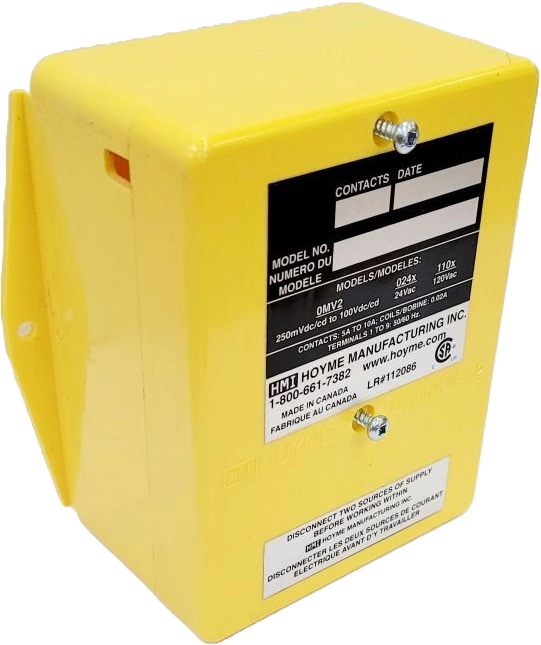
That means a motorized damper in the make-up air duct, and the damper has to know when the exhaust fan is on. On a 120 Vac fan, the switch that starts the fan is the signal. The ADP-1101-05A is what turns that signal into damper operation.
The ADP-1101-05A
It sits between the 120 Vac fan circuit and the 24 Vac damper. Ventilation switch closes, the fan starts, the ADP sees line voltage on its input and operates the damper. Switch opens, fan stops, damper goes back to its resting position.
No timer. No delay. No proving loop. The fan and the damper work off the same switch, which is what this application actually needs. Nothing is being held off and nothing is waiting for confirmation. The damper is supplying air while air is being removed, and that is the whole job.
Worth being clear about the difference, because contractors who have wired combustion air interlock sometimes expect this to behave the same way. On a combustion air installation the damper end switch holds the appliance off until the damper is proven open, and the end switch is mandatory because the appliance is not permitted to fire without it. Make-up air is not that. There is no ignition sequence to gate. The point is building pressure, not appliance safety proving.
Colour wiring diagram is in the box. Relays are field replaceable. The A/C circuit is not affected by the relay logic on any ADP model.
Power Open or Power Close
The make-up air damper is a standard HAC inline damper and the action is a real decision, not a default.
Power close means the spring holds the damper open and 24 Vac closes it. Wired through the ADP-1101-05A, that damper opens when the ventilation fan runs and can also be set up to open on a call for heat. This is diagram 6B5, and it is the one most people are looking for.
Power open is the opposite. The damper stays shut during furnace firing and opens only when the ventilation fan runs. That is diagram 6A.
Which one is right depends on whether the design wants make-up air during heating cycles or only during exhaust events. That is a mechanical design question, not a product question. Sort it out before the order goes in, because PO and PC are not something you swap once the damper is in the duct without getting at the actuator.
Which Diagram to Follow
The ADP-1101-05A shows up in more wiring diagrams than any other adaptor in the series, because exhaust fan and make-up air combinations vary more than combustion air ones do. The useful starting points:
- 6B5. One ventilation fan, power close damper with relay, opens on a call for heat and with the designated ventilation fan. This is the standard.
- 6A. Same layout with a power open damper that stays closed during furnace firing.
- 5. Exhaust fan opens a power close damper and turns on the furnace fan, without interfering with combustion air damper operation.
- 6A1 and 6A2. Multiple ventilation fan switches feeding one damper.
- 6A3. Two separate ventilation and exhaust fans, two ADP-1101-05A adaptors, combustion air damper on the same system.
They are all in the Technical Library. If what is on the job does not match a published diagram, call first. It is a shorter conversation before the wire is pulled than after.
Make-Up Air Is Not Combustion Air
These get conflated on job sites and they should not be.
Combustion air feeds the appliance. It is sized to the appliance, interlocked to the appliance, and on a motorized intake the appliance cannot fire until the damper proves open.
Make-up air replaces what an exhaust fan removes from the building. Sized to the exhaust rate, operates with the fan.
A house with a serious range hood and an atmospherically vented appliance needs both, and several of the published diagrams show them on the same system for exactly that reason. Two dampers, two jobs, not a redundancy.
What to Order
- ADP-1101-05A for a 120 Vac exhaust fan interlocking a make-up air damper
- HAC inline damper sized to the make-up air duct, PO or PC per the design
- OOH or BDH exterior hood at the termination
For related arrangements, the ADP-1101-10AV runs one exhaust fan on its own from a primary switch and together with the furnace fan and fresh air damper from a designated ventilation switch. The ADP-1101-10AS keeps two exhaust fans from running at the same time and must be wired with an ADP-1101-05A or ADP-1102-TWP. Where the exhaust fan must wait for the damper to prove open, use a TPX proving adaptor instead.
High volume kitchen exhaust is a different animal with its own proving requirements. If that is what you are sizing for, call 1-800-661-7382 before you order rather than after.
View All Colour Wiring Diagrams
Hoyme Manufacturing is a CSA-certified manufacturer of motorized dampers and airflow controls based in Camrose, Alberta. Products are available through HVAC wholesalers across Canada.