
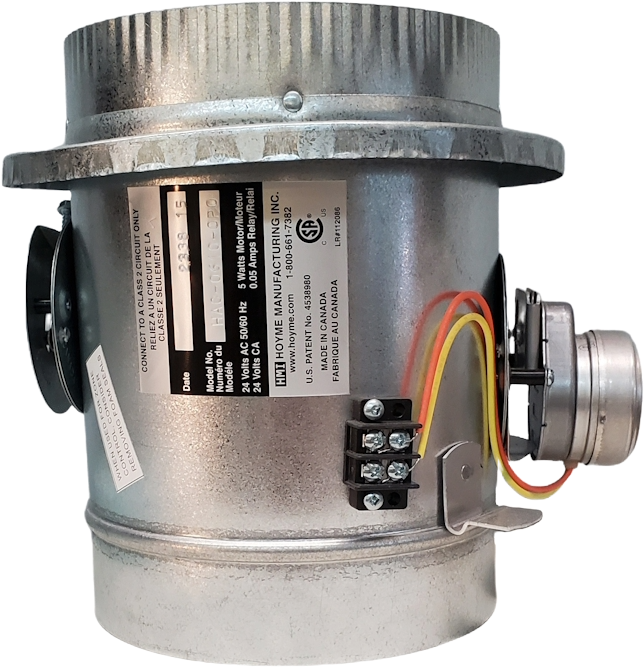
A motorized fresh air damper arrives on site. The contractor installs it, wires it up, and calls for ventilation. The damper opens when it should have closed. Part number is right. Size matches the duct. The action is wrong.
Power Open and Power Close look identical in the box. You can't tell which one you have until the unit is wired and energized. If you ordered the wrong one, you either pull it out or change the configuration on site. This guide covers how to choose the right action before the damper ships and what happens if something changes after it arrives.
What Power Open and Power Close Actually Mean
The action code describes what the damper does when power is removed, not what happens when it is energized. That is the detail most people miss.
PO, Power Open. Apply 24 Vac and the damper opens. Remove power and the spring closes it. When the system is off, the duct is sealed.
PC, Power Close. Apply 24 Vac and the damper closes. Remove power and the spring opens it. When the system is off, the duct is open.
Neither one is the right answer by default. Each one is the wrong answer in the wrong application.
Fresh Air Intake and Make Up Air
Power Open is correct for the vast majority of fresh air intake and make up air jobs.
On a fresh air intake you want the duct sealed when the system is not running. That is what you get with PO. Power is off, spring is closed, duct is sealed. Between ventilation cycles the building stays sealed against outdoor air infiltration, wind pressure at the exterior termination, and cold air in winter. When ventilation is called, 24 Vac opens the damper. Cycle ends, power drops, spring closes it.
Power Close on a fresh air intake means the duct sits open whenever power is off. That is the wrong direction for a standard residential installation. PC on a fresh air application is only specified when the system design specifically requires the duct to stay open on a power failure, which is uncommon in residential work but does come up on certain exhaust control and pressure relief designs.
HRV and ERV Duct Control
Power Open is standard for HRV and ERV fresh air duct applications. The HAC goes on the fresh air supply duct and opens when the unit calls for a ventilation cycle. When the cycle ends the spring closes the damper and seals the fresh air duct.
That seal matters more than most contractors expect. A passive installation without a motorized damper leaves the HRV core as an infiltration path when the unit is off. Outdoor air moves through the core and into the building. The HAC closes that path. Power Open is the right action because the damper seals on power loss, which is the same condition as the unit being off between cycles.
Zone Control
Zone control is the highest volume application for the HAC across the Hoyme wholesaler network and it requires the most care on action selection because the right answer depends on the system.
For return air zone control, Power Open works in most configurations. For zone damper applications on variable speed systems, either action can be appropriate depending on how the zone control panel handles the 24 Vac signal. Confirm with the zone control manufacturer's wiring documentation before selecting the action. Getting this wrong on a zone system is worse than getting it wrong on a single fresh air damper because the dampers are in every zone and pulling them is a significant callback.
For supply air zone control on a single speed furnace, the standard HAC is not the right product regardless of which action you pick. Use the HAC H with the 10 percent heat bypass blade. On a single speed furnace, closing all supply zones at the same time the furnace fires pushes the full air volume against a blocked system. Static pressure climbs, heat exchanger airflow drops, and high limit switches trip. The bypass blade machined into the HAC H maintains minimum airflow through each closed zone and prevents that from happening. The standard HAC works on supply zone control only if the system design accounts for full shutoff across all zones at once.
Ventilation Code Compliance
Where the fresh air damper is interlocked with the furnace fan on a 24 Vac ventilation switch, the standard configuration is a Power Open HAC with an ADP-0241-05A relay adaptor. For a 120 Vac exhaust fan switch, use the ADP-1101-05A.
The sequence works like this. Ventilation is called. The ADP opens the HAC and turns on the furnace fan at the same time. When the call ends, the fan stops and the spring closes the damper. These adaptors do not wait for the damper to prove open, so the HAC does not need an end switch for them.
Where an exhaust fan must not run until the replacement air damper has proved open, use a proving adaptor (ADP-1102-TPX, ADP-1103-TPX or RADP-1102-TPX) with an end switch damper.
The End Switch and Relay
The action controls the fail safe direction. The end switch and relay are separate options that add capability to the same unit without changing the action.
End switch, S prefix in the part number. Sends a signal back to the controller confirming the blade has physically reached the commanded position. Required with the proving adaptors (TPX models) and the gas dryer adaptors. Available on all sizes.
Relay, 11 motor code in the part number. Provides a switched output that activates when the damper opens. Use it when the damper opening needs to energize a furnace fan, an exhaust fan interlock, or another device. Not available on 2 inch and 3 inch sizes.
Both options can be ordered on the same unit. A 6 inch HAC with Power Open action, relay included, and end switch included is a HAC-0611-SPO.
If the Action Needs to Change After Installation
On the Hoyme HAC the actuator is accessible for OPO to OPC configuration changes in the field if requirements change after the damper is in the duct. That is not the case on every product in this category. Some manufacturers do not allow field changes at all. Getting the action right before the order is still the better outcome, but if the specification changes or an error is caught on site the Hoyme actuator can be accessed and reconfigured rather than pulling the damper and ordering a replacement.
If the application is unclear before the order is placed, call technical support at 1-800-661-7382. Power Open is the right default for residential fresh air and HRV work, but a two minute call before the order goes in is faster than a site visit after the damper is in the wall.
How to Read the Part Number
The HAC part number encodes the complete configuration in order. Here is how to read it:
- HAC is the product family
- The two digit size code: 04 is 4 inch, 05 is 5 inch, 06 is 6 inch, 07 is 7 inch, 08 is 8 inch, 09 is 9 inch
- The relay digit: 0 means no relay, 1 means relay included
- S or O before the action code: S means end switch included, O means no end switch
- PO or PC at the end: the action
A few working examples:
- HAC-0610-OPO is a 6 inch, no relay, no end switch, Power Open
- HAC-0610-OPC is a 6 inch, no relay, no end switch, Power Close
- HAC-0611-SPO is a 6 inch, relay included, end switch included, Power Open
- HAC-0510-OPO is a 5 inch, no relay, no end switch, Power Open
Quick Reference Before You Order
- Fresh air intake and make up air: Power Open
- HRV and ERV fresh air duct control: Power Open
- Fresh air interlocked with the furnace fan: Power Open with ADP-0241-05A (24 Vac switch) or ADP-1101-05A (120 Vac exhaust fan)
- Return air zone control: confirm with zone control system documentation
- Supply zone control on a single speed furnace: HAC H, not standard HAC
- Application requires duct open on power loss: Power Close
- Not sure: call 1-800-661-7382 before the order goes in
View the HAC Inline Air Control Damper
Hoyme Manufacturing is a CSA certified manufacturer of motorized dampers and airflow controls based in Camrose, Alberta. Products are available through HVAC wholesalers across Canada.