
If you are installing a furnace, boiler, fireplace, or atmospheric water heater in new construction or a major renovation, there is a good chance the authority having jurisdiction expects a controlled combustion air intake. Whether a motorized damper is required, and how it needs to be interlocked, comes up regularly at the counter and on inspections.
This guide covers the code basis, how interlock is supposed to work, and what to watch for when selecting a damper and relay adaptor.
The Code Basis: CAN/CSA B149
Combustion air requirements for fuel-burning appliances in Canada fall under CAN/CSA B149, the Natural Gas and Propane Installation Code. The relevant provisions require that appliances have an adequate supply of air for combustion, ventilation, and draft. On tighter modern construction, that means a designated controlled opening rather than relying on infiltration through the building envelope.
When that opening is motorized and can be closed while the appliance is off, the code requires it to be interlocked. The appliance cannot fire until the damper is confirmed open. A sealed building with a closed combustion air intake and a firing furnace will draw air from wherever it can find it: plumbing penetrations, exhaust fans, any available gap. The result is negative building pressure, combustion quality problems, and carbon monoxide risk. Interlock is the protection against that.
Requirements vary by edition of B149 and by jurisdiction. Some municipalities have adopted amendments. Confirm local requirements with the authority having jurisdiction before finalizing a design.
When a Motorized Damper Is Typically Required
A motorized combustion air damper is generally required when the combustion air opening is equipped with a closeable control device, which is exactly what a motorized damper is. It also applies when the building is tight enough that natural infiltration cannot reliably supply combustion air, when the mechanical engineer's design specifies a controlled intake, or when the appliance manufacturer's instructions call for a controlled combustion air source.
For permanently open passive openings, such as a fixed louvred intake or open grille, a motorized damper is not required. The requirement comes in once you introduce something that can close the opening.
How the Interlock Works
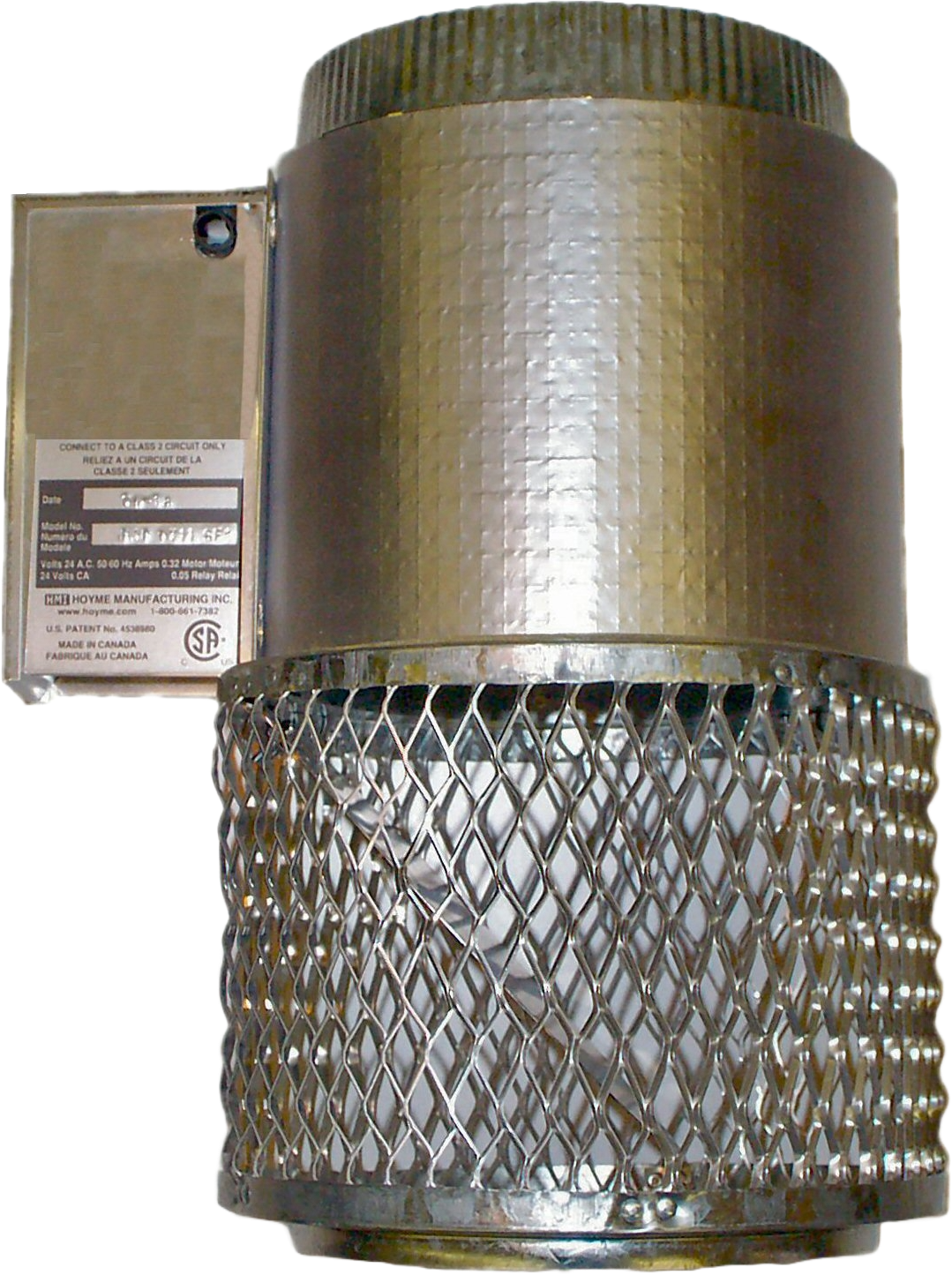
The Hoyme HOM is interlocked directly with the appliance safety circuit. Between firing cycles the damper is held closed by power from the appliance transformer, or from an auxiliary transformer where the appliance transformer is not suitable. When the thermostat calls for heat, power to the damper motor is cut and the damper drops open by gravity. The HOM end switch is wired in series with the thermostat wire to "W", so the call for heat only reaches the appliance once the blade has opened.
- The appliance is off and the HOM is powered closed.
- The thermostat calls for heat.
- The HOM relay cuts power to the motor and the damper drops open.
- The end switch closes as the blade opens and completes the circuit to "W".
- The appliance fires.
- When the call ends, the appliance shuts down and the damper is powered closed again.
Because the HOM uses power to close and none to open, a power failure or a failed motor leaves the combustion air path open. If the blade is stuck or frozen closed, the end switch never makes and the appliance does not fire. That is the correct failure direction for a combustion air intake, and it is why the end switch matters: it makes the interlock prove the damper opened, not just that a signal was sent.
Selecting the Right HOM
The HOM comes in two models, in 4" through 9" diameters:
- SF1 interlocks to one appliance. A 6" damper for one furnace is an HOM-0611-SF1.
- SF2 interlocks to two appliances, such as a furnace and a water heater in the same room. Install the SF2 on, or nearest to, the largest appliance.
Both models include the relay, the end switch and a TEST/RUN switch, so there is no separate end switch option to remember on the HOM.
Size the combustion air duct to the code in force. Where no sizing code applies locally, the HOM installation instructions give 1.0 sq. in. of duct cross-section per 7,000 BTUH of total input rating of all appliances in the area.
Do You Need an ADP Relay Adaptor?
Only when the appliance safety circuit is not 24 Vac.
- 24 Vac furnaces and boilers: no adaptor. The HOM wires directly into the 24 Vac thermostat or aquastat circuit.
- Millivolt systems (standing pilot with a thermopile or thermocouple): ADP-0MV2-S5A.
- 120 Vac safety controls, common on tankless water heaters and some boilers: ADP-1102-S5A.
Wire the HOM into the appliance safety circuit exactly as shown in its installation instructions. If the existing safety circuit is not fused, as on some older furnaces, install an in-line fuse between the thermostat wire and HOM wire #1.
Installation Notes Worth Knowing
- The HOM fastens to the terminating end of the fresh air inlet duct inside the appliance area. Mount the bracket vertically, with the bottom of the bracket within one foot above burner level and within two feet horizontally of the front of the appliance.
- Leave the TEST/RUN switch in the up (RUN) position for normal operation. The down position holds the damper open and bypasses the interlock for troubleshooting.
- Where one damper cannot supply enough combustion air, as on larger commercial appliances, several HOM dampers can be connected together and mounted in modules.
- A power close HAC fresh air damper can be connected to HOM terminals 4 and 5 so it opens with the HOM during firing, where the authority having jurisdiction accepts it.
- Sequence the appliance through at least three normal cycles after installation, and inspect the damper and appliance annually.
The HOM at a Glance
The Hoyme HOM Motorized Combustion Air Damper is Canada/USA CSA certified, available in 4" through 9" diameters, in SF1 (one appliance) and SF2 (two appliance) versions. It carries a 2-year electrical warranty and a 10-year mechanical warranty.
View the HOM Combustion Air Damper
Hoyme Manufacturing is a CSA-certified manufacturer of motorized dampers and airflow controls based in Camrose, Alberta. Products are available through HVAC wholesalers across Canada.