
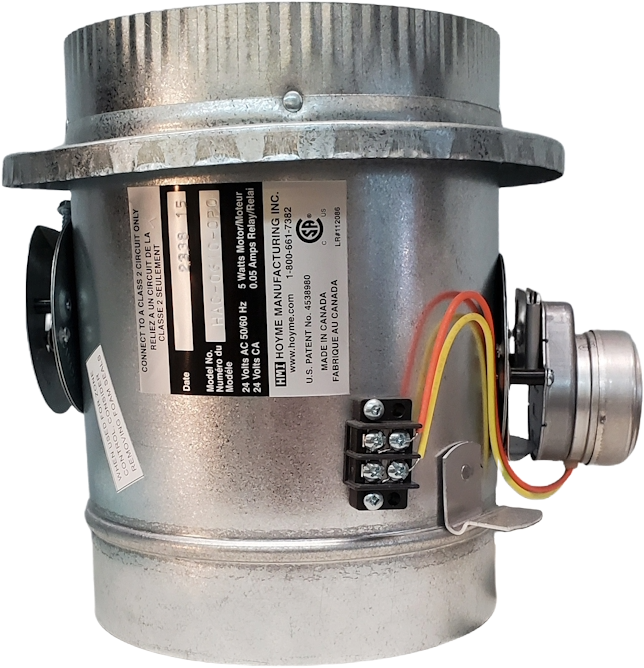
A mechanical plan calls for a fresh air duct. Somebody orders a combustion air damper. It gets installed, it gets wired, and it does not do what the plan intended because the two systems are not the same thing and they do not use the same part.
This happens because all three of these systems look identical from ten feet away. A duct from the outside, a damper in the duct, a wire to the damper. The difference is what the air is for, what the damper has to prove, and what happens when power is lost. Get those wrong and the install either fails inspection or creates a problem that surfaces months later.
The Short Version
| System | What the air is for | Damper | Must it prove open? |
|---|---|---|---|
| Combustion air | Feeding the burner on a fuel-burning appliance | HOM | Yes. The appliance cannot fire until it does. |
| Fresh air | Indoor air quality and ventilation code | HAC | No. It opens with the furnace fan. |
| Make-up air | Replacing air an exhaust fan removes | HAC or MAC | Usually no. It opens with the fan. |
If that table answers your question, you are done. If you want to know why, keep going.
Combustion Air: Feeding the Appliance
Combustion air is the air a furnace, boiler, water heater, or fireplace needs to burn its fuel. It is sized to the appliance and it exists for one appliance or one group of appliances sharing a duct.
This is the one with real code weight behind it. On a permitted residential or commercial installation in Canada and the US, a combustion air damper has to be interlocked with the appliance it serves. The appliance is not allowed to fire until the damper proves it is open.
The reason is straightforward. A fuel-burning appliance that fires without a proved open combustion air path pulls its air from inside the building instead of from outside. In a sealed house that means the appliance runs under negative pressure, pulling air past backdraft hazards and potentially down unsealed chimneys and other appliance vents. Combustion quality drops, carbon monoxide production rises, and the risk of backdrafting combustion products into the living space goes up on every firing cycle.
The product is the HOM. It uses power to close and drops open by gravity when power is removed, which is the correct fail safe direction for combustion air. Lose power mid cycle and the damper drops open, keeping the combustion air path clear.
On a 24 Vac furnace or boiler, the HOM wires directly into the thermostat or aquastat circuit. Its built-in end switch is in series with the thermostat wire, so the appliance cannot fire until the damper has opened. No adaptor is needed. An ADP relay adaptor is only needed for other safety circuit voltages:
- ADP-0MV2-S5A for a gas furnace on a millivolt safety system, meaning standing pilot with a thermopile or thermocouple. This is the only model rated for millivolt levels.
- ADP-1102-S5A for a boiler or tankless water heater at 110 Vac, up to a 5A load.
More detail in the combustion air code guide and the ADP selection guide.
Fresh Air: Ventilation for the Occupants
Fresh air is about indoor air quality, not combustion. It supplies outdoor air to the living space on a ventilation schedule, and it is sized to the ventilation rate the code requires for the building rather than to any appliance.
The product is the HAC, installed inline in the fresh air duct run. Power Open is correct for the vast majority of fresh air installations. The damper opens when ventilation is called and the spring closes it when the call ends, so the duct is sealed between cycles against outdoor air infiltration, wind pressure at the exterior termination, and cold air intrusion.
Where the code requires a fresh air intake damper interlocked with the furnace fan, the damper and the fan run together on a ventilation call. Where the fresh air joins the return, and how much outdoor air is drawn, decide how well it is tempered before it reaches the registers.
The ADP-0241-05A handles that interlock on a 24 Vac ventilation switch, opening the HAC and turning on the furnace fan together. On a 120 Vac exhaust fan switch, use the ADP-1101-05A. Neither needs an end switch on the damper.
For HRV and ERV installs, the HAC goes on the fresh air supply duct and opens when the unit runs. That matters more than people expect, because a passive fresh air installation leaves the HRV core as an open infiltration path whenever the unit is off.
More detail in the Power Open vs Power Close guide and the cold air from the vents guide.
Make-Up Air: Replacing What Gets Exhausted
Make-up air is neither of the above. It is not feeding an appliance and it is not on a ventilation schedule. It replaces air that an exhaust fan removes from the building, and it is sized to the exhaust rate.
Run a large range hood, a downdraft cooktop, or a high volume bath fan in a sealed house and that air has to come back from somewhere. If there is no controlled path, it comes from the lowest resistance opening available, which is usually an appliance vent. That is backdrafting, and it is the same failure mode as an uninterlocked combustion air intake arriving from a different direction.
The product is a HAC in the replacement air duct, or a MAC if you want the damper and the exterior hood combined in one wall unit. The interlock is to the exhaust fan rather than to an appliance, so the damper opens while the fan runs instead of gating an ignition sequence.
Gas dryers are a make-up air application too. The RADP-0241-S10A handles a 24 Vac circuit. A manual switch with a red indicator light opens the damper and proves it open before the receptacle the dryer plugs into becomes live. The RADP-0242-S10A covers jobs where two dampers must both prove open. For a 110 Vac dryer interlock, call technical support.
Why These Get Confused
Because on a drawing they look the same. Duct, damper, wire.
The difference is not visible in the ductwork. It is in three questions:
- What is the air for? Burning fuel, breathing, or replacing what a fan removed.
- What sizes it? The appliance, the ventilation rate, or the exhaust rate.
- What is it interlocked to? An appliance safety circuit, a ventilation controller and furnace fan, or an exhaust fan switch.
Answer those three and the product selects itself.
Can One Damper Do Two Jobs?
Sometimes, and it is documented rather than improvised.
Wiring diagram 8A3 shows a combustion air damper on a forced air furnace also supplying replacement air for a 120 Vac gas dryer through an RADP-0241-S10A. One damper, two functions, published wiring.
More often though these are separate dampers on the same system. Diagram 3 shows a combustion air damper interlocked to a furnace alongside a separate power close fresh air damper. Diagram 6A3 shows a combustion air damper with two separate ventilation and exhaust fans running two ADP adaptors and a replacement air damper.
A house with a sealed envelope, an atmospherically vented appliance, a code required ventilation rate, and a serious range hood needs all three systems. That is a normal Canadian new build, not an unusual one.
Do not combine functions on your own judgement. If a single damper is going to serve two purposes, follow a published wiring diagram or call before you wire it.
Picking the Right Part
Once you know which system you are building, the variant questions are short.
- Size. Match the damper to the duct diameter exactly. The HAC covers 2 inch through 9 inch on the standard drive.
- Action. Power Open or Power Close. It cannot be swapped after the damper is in the duct without getting at the actuator, so settle it before the order.
- End switch. Built into every HOM (SF1 and SF2). On the HAC, required with the proving adaptors (TPX models) and the gas dryer adaptors, so order SPO or SPC. The ADP-0241-05A and ADP-1101-05A use OPO or OPC.
- Relay. Include it when the damper opening needs to energize something else. Not available on 2 inch and 3 inch.
Then the situational variants. HAC-H if it is supply zone control on a single speed furnace, because full shutoff on all zones spikes static pressure and trips the high limit. HAC-L if the damper location is prone to condensation. HAC-12 if there is no low voltage circuit at the damper and you only have 120 Vac. HAC-F if it is a flue application, which is a different product with a different fail safe direction entirely.
The HOM, MAC, MOH, standard HAC and HAC-12 are Canada/USA CSA certified. The standard line carries a two year electrical and ten year mechanical warranty.
If You Are Not Sure
Call before the order goes in rather than after the damper is in the wall. Technical support is 1-800-661-7382 and it costs nothing. Full colour wiring diagrams for every configuration described here are in the Technical Library.
View the full Hoyme product line
Find a stocking wholesaler near you
Hoyme Manufacturing is a CSA-certified manufacturer of motorized dampers and airflow controls based in Camrose, Alberta. Products are available through HVAC wholesalers across Canada.