
Minus 25 and a furnace that will not stay running right. Service call goes out. The combustion air damper opens on the call, the end switch makes, the ADP releases the safety circuit, the appliance fires. Everything in the interlock does exactly what it is supposed to do.
Then somebody goes outside and finds the intake hood packed solid with drifted snow.
The damper was open. Air was not moving. The interlock had no way to tell the difference, because that is not what it was built to tell you.
What the End Switch Actually Reports
An end switch is a position device. The blade swings, the lever arm reaches it, the contact closes. That contact means one thing: the blade got where it was told to go.
That is genuinely useful and for most installations it is the right level of proof. It catches the failures that actually happen most often, which are a dead motor, a seized blade, a broken linkage, or somebody ordering the damper without the end switch in the first place. Those are real and they are common and position proving finds all of them.
What it cannot report on is anything that happens somewhere else in the duct.
Where Position and Flow Stop Agreeing
The damper blade is one point in a run that might be fifteen feet long with a hood on the end of it. The end switch has visibility into that one point and nothing else.
Which means all of this reads as open:
- Intake hood drifted shut with snow, which is a wall orientation problem as much as a weather one
- Ice built up across the hood opening after a thaw and refreeze
- Screen packed with cottonwood fluff, grass clippings, or dust from a gravel road
- Flex duct crushed behind drywall by somebody who needed the space
- A bird or a wasp nest built in the duct over the summer
- Insulation or vapour barrier pulled into the run during another trade's work
- A damper somewhere else in the system closed when it should not be
In every one of those the blade moves, the switch makes, and the appliance is released to fire against an air path that is not there.
Why It Is a Winter Problem
Most of that list is seasonal and it clusters in the same eight weeks.
Snow drifts into passive openings. Thaw and refreeze builds ice across a screen. And the building is sealed tight at exactly the same time, so there is less infiltration making up the difference than there would be in October.
The intake is most likely to be blocked on the same days the appliance is working hardest. That is the part worth sitting with.
When Position Proving Is Enough
Most of the time, and it is worth being straight about that rather than talking anybody into something they do not need.
A standard residential combustion air install with a short duct run, a motorized termination at the wall, and an accessible hood is well served by an end switch in an ADP interlock. That is what the code requires, it is what the published wiring diagrams are built around, and it addresses the failure modes that actually turn up on service calls.
Adding flow proving to that installation is not wrong, it is just solving a problem that installation does not have.
When It Is Worth Proving Flow
The calculus changes when the duct run itself becomes a place something can go wrong without anybody seeing it.
Worth considering when:
- The run is long or concealed. Fifteen feet through a ceiling space is fifteen feet nobody inspects.
- The termination is exposed or hard to reach. A hood on a windward wall two storeys up does not get looked at until something goes wrong.
- The building is commercial or multi family. Nobody lives there watching it, and the person who would notice a problem is not the person who owns it.
- The control sequence calls for it. Some sequences require flow confirmation rather than position confirmation, and that is a design decision rather than a field one.
- The authority having jurisdiction asks for it. It comes up, particularly on commercial work.
- A BAS or DDC panel needs an airflow status point. Position is not a flow point and a controller expecting one will not accept it.
The PFS
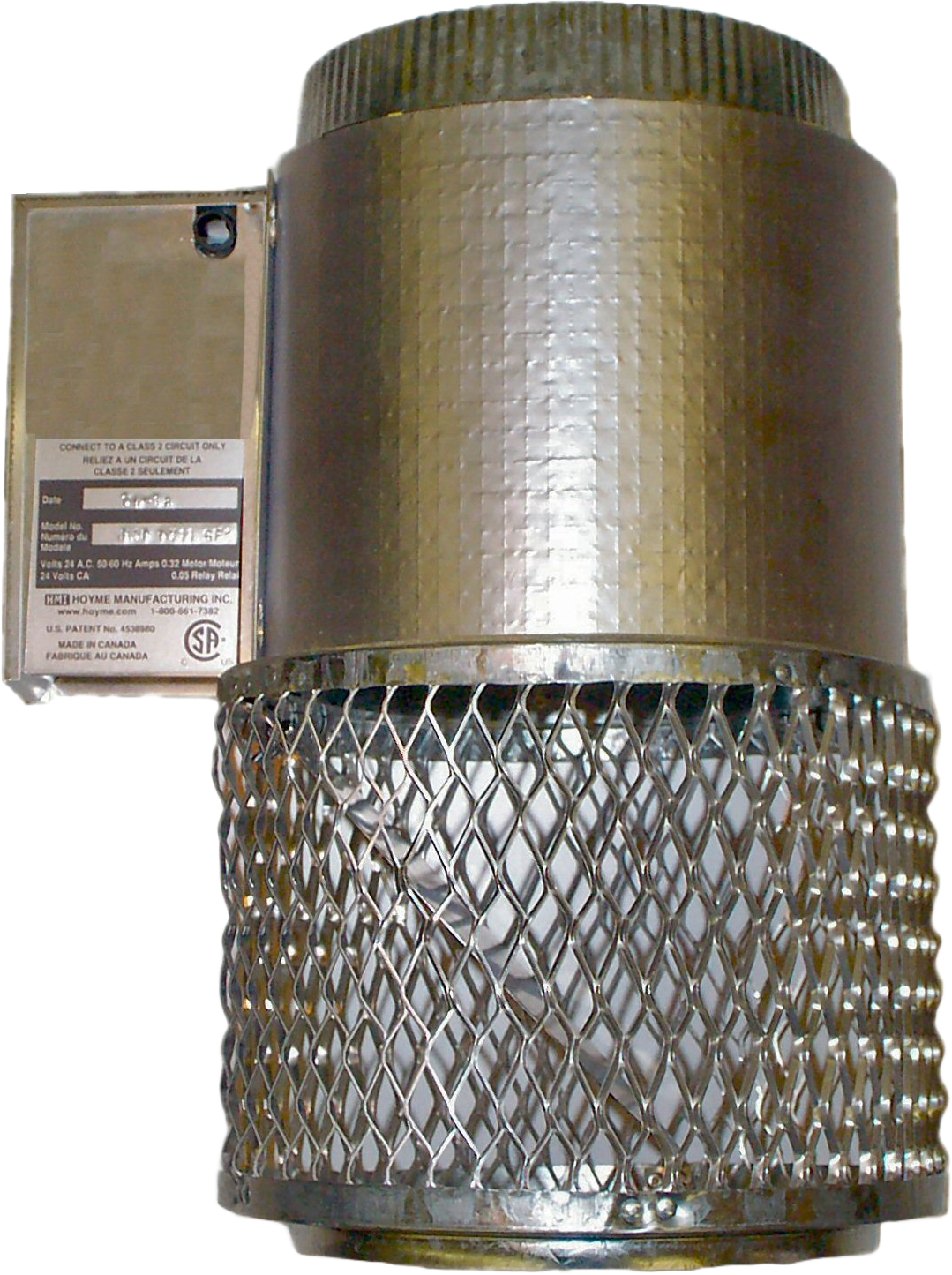
The PFS Positive Flow Switch proves actual airflow in the duct rather than blade position alone. It mounts in the run and reports on what is moving through it.
Available for 4, 5, 6, 7, 8 and 9 inch round duct, in a 24 Vac version and a 120 Vac version to match whatever the control circuit is running on.
It does not replace the end switch and it is not an argument against position proving. The two answer different questions. The end switch tells you the damper did its job. The flow switch tells you the duct is doing its job. On an installation where both can fail independently, proving both is the complete answer.
In a Specification
If you are writing this into a project rather than deciding it in the field, the distinction belongs in the sequence narrative rather than the product schedule.
Say which device proves what, and what is permitted to operate next. Position proving and flow proving are different requirements and a spec that just says the damper shall prove open leaves it to whoever is pricing the job to decide which one that means.
Same principle as the rest of the interlock. Schedule it, do not delegate it. More on that in the damper specification post.
The Cheap Version of This
Worth saying, because not every job justifies another device.
If you are not adding flow proving, then the termination needs to be somewhere a person will actually look at it. A hood at grade on a sheltered wall gets noticed when it drifts shut. The same hood at second floor level on the windward side does not.
And a motorized termination that closes between cycles has nothing standing open to collect snow in the first place, which removes the most common blockage on the list. That was the subject of the last post and it applies here for a different reason.
Position of the termination is a design decision that gets made once and lived with for thirty years. Worth five minutes at the drawing stage.
Sorting It Out on a Job
The question to answer is whether anything between the damper blade and outdoor air can fail without somebody noticing.
Short accessible run with a motorized termination, probably not, and position proving covers it. Long concealed run with an exposed hood on a commercial building, probably yes, and that is the case for proving flow as well.
If you are working through it on a specific installation, or you need PFS sizing and wiring detail for a sequence, call 1-800-661-7382.
Technical Library: installation instructions and colour wiring diagrams
Related: selecting the right ADP relay adaptor
Hoyme Manufacturing is a CSA certified manufacturer of motorized dampers and airflow controls based in Camrose, Alberta. Products are available through HVAC wholesalers across Canada.