
The zone control system is installed, the thermostats are wired, and everything checks out on the initial startup. A few weeks later the homeowner calls. The furnace is short cycling. The high limit is tripping. One zone is not heating properly. The contractor goes back and finds nothing obviously wrong: the dampers are opening and closing, the wiring is correct, and the furnace itself is fine.
The problem is not the furnace and it is not the wiring. It is what happens to airflow when all the supply zone dampers close at the same time on a single speed furnace, and the fix is a component that should have been specified at the start.
What a Single Speed Furnace Cannot Do
A single speed furnace runs at one output level. When it fires, it moves a fixed volume of air at a fixed static pressure. The system is designed around that volume moving through all the open ductwork simultaneously.
On a zone control system, the supply dampers for each zone open and close independently based on each zone thermostat. When only one zone is calling, the other supply dampers close. The furnace fires and tries to push its full air volume through the one open zone. Static pressure in the supply plenum climbs immediately. The heat exchanger, which depends on airflow to stay within its operating temperature range, starts to overheat. The high limit switch trips and shuts the furnace down before the heat exchanger is damaged.
That is the failure mode. It is not a furnace fault and it is not a thermostat fault. It is a physics problem: too much air volume, not enough open ductwork to move it through.
Why This Does Not Happen on Variable Speed Systems
A variable speed or two-stage furnace modulates its output to match the current load. When only one zone is calling and the other supply dampers are closed, the furnace drops its output to match the reduced airflow capacity. Static pressure stays within range, the heat exchanger stays at operating temperature, and the high limit never sees the condition that would cause it to trip.
On a single speed furnace there is no modulation. Output is fixed. If the ductwork capacity drops below what the furnace needs to move its air volume, something has to give, and it is always the high limit.
The Fix: HAC-H with 10% Heat Bypass
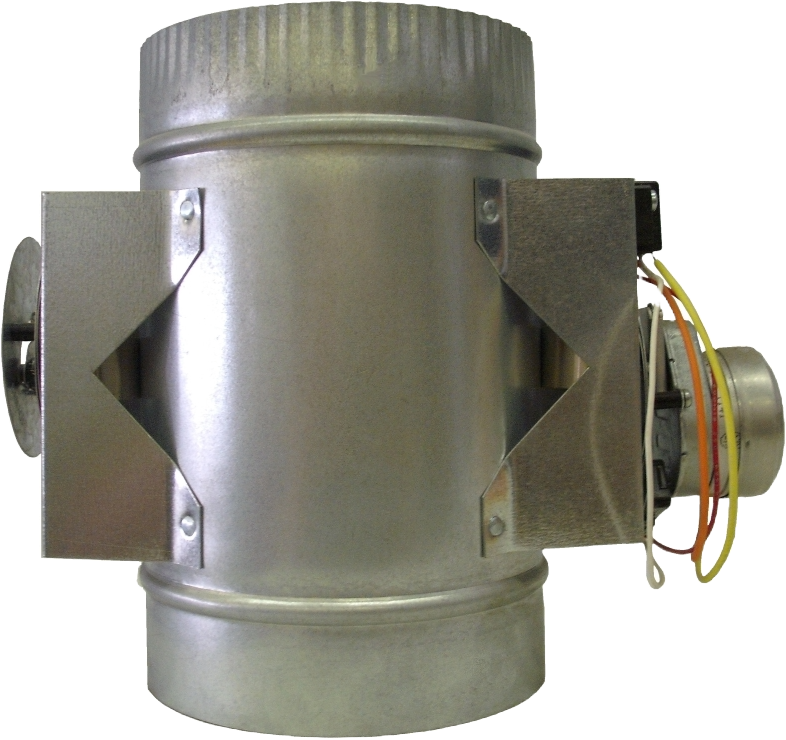
The correct supply zone damper for a single speed forced air system is the Hoyme HAC-H, not the standard HAC. The HAC-H has a 10% heat bypass blade machined into the damper. When the zone damper closes, the blade seals 90% of the duct cross-section but leaves 10% permanently open regardless of the control signal.
That 10% opening is what prevents the static pressure spike. With every zone damper partially open at minimum, the furnace always has a path for its air volume. Plenum pressure stays within range, heat exchanger airflow is maintained, and the high limit never reaches trip threshold even when only one zone is actively calling.
The 10% bypass is machined into the blade. It is not adjustable and not field-installed. It is the correct specification from the order, and it is the only reliable solution for supply zone control on a single speed forced air system.
When to Use the Standard HAC vs the HAC-H
The distinction is straightforward:
- Return air zone control: Standard HAC is correct. Return air ductwork operates at negative pressure relative to the living space and the static pressure failure mode does not apply in the same way. Full shutoff on return air zones is acceptable on most systems.
- Supply air zone control on a variable speed or two-stage furnace: Standard HAC is acceptable. The furnace modulates to match reduced airflow and the high limit concern does not apply.
- Supply air zone control on a single speed furnace: HAC-H required. Every supply zone damper on the system needs the bypass blade. Mixing HAC-H and standard HAC on the same single speed system creates zones where the bypass works and zones where it does not, which is inconsistent and can still cause high limit trips depending on which combination of zones closes simultaneously.
Sizing the HAC-H
The HAC-H uses the same sizes as the standard HAC: 2" through 9" round duct. Match the damper diameter to the supply duct diameter at the installation point. The 10% bypass is consistent across all sizes. The part number structure is identical to the standard HAC with an H suffix:
- HAC-0611-OPO-H = 6", relay included, no end switch, Power Open, heat bypass
- HAC-0811-OPO-H = 8", relay included, no end switch, Power Open, heat bypass
- HAC-0511-OPC-H = 5", relay included, no end switch, Power Close, heat bypass
Confirm the correct action (Power Open or Power Close) before ordering. The same rules apply as the standard HAC. For supply zone control the common configuration is Power Open, but confirm with the zone control panel manufacturer's wiring documentation.
If the System Is Already Installed with Standard HAC Dampers
If a zone control system is already in service with standard HAC dampers on the supply runs and the high limit is tripping, the dampers need to be replaced with HAC-H. There is no field modification that replicates the machined bypass blade on a standard HAC. The bypass is a physical feature of the blade casting. It is not something that can be added after the fact.
The replacement procedure is straightforward. Replace each supply zone damper with the equivalent HAC-H in the same size and action configuration. Return air zone dampers using standard HAC do not need to be changed.
If the system has been running and the high limit has been tripping repeatedly, inspect the heat exchanger before putting the system back in service. Repeated high limit trips on a gas furnace are a heat exchanger stress event and the exchanger should be checked for cracks before the repaired system is handed back to the homeowner.
What to Specify on New Installations
On any new zone control installation on a single speed forced air furnace, the specification is:
- HAC-H for all supply zone dampers
- Standard HAC acceptable for return air zone dampers
- Confirm with the zone control panel manufacturer how many zones can close simultaneously and what the minimum open duct area requirement is for the specific furnace
The 10% bypass in the HAC-H is a minimum bypass designed to prevent high limit trips on typical residential forced air systems. On commercial systems or high-output residential systems with large furnaces and many zones, confirm the bypass area is sufficient for the specific equipment before finalizing the specification.
For help selecting the right configuration for a specific job, call technical support at 1-800-661-7382.
View the HAC-H Heat Bypass Damper
Read the HAC action selection guide: Power Open vs Power Close
Hoyme Manufacturing is a CSA-certified manufacturer of motorized dampers and airflow controls based in Camrose, Alberta. Products are available through HVAC wholesalers across Canada.