
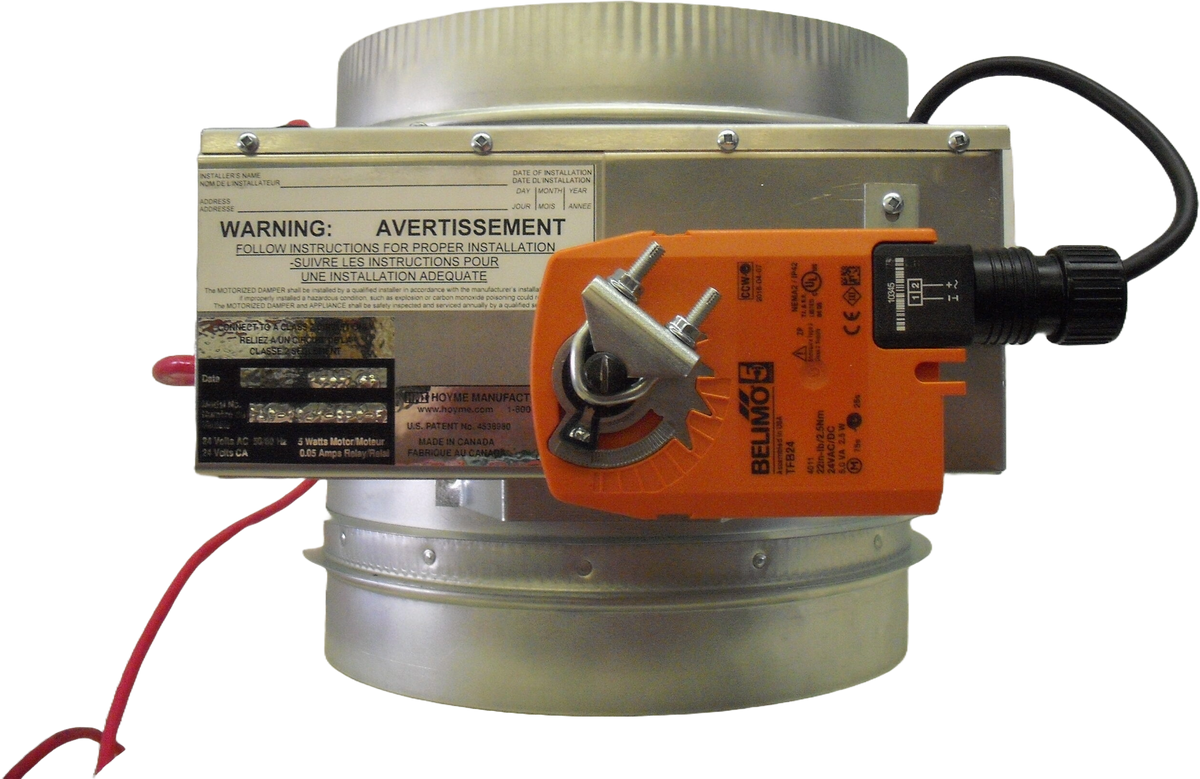
A 600 CFM range hood in a tight house has a problem the homeowner never sees. Every minute it runs, it pulls 600 cubic feet of air out of the building, and that air has to come back in from somewhere. Without a planned path, it comes down the water heater flue, through the furnace vent, or under the doors, and the hood moves far less air than it was sold to move.
That is why the International Residential Code puts a make-up air requirement on large kitchen exhaust.
What the code says
Kitchen exhaust hoods capable of more than 400 CFM need make-up air supplied at a rate approximately equal to the exhaust rate. The make-up air system needs at least one damper, and that damper has to be either a gravity damper or an electrically operated damper that opens automatically when the exhaust runs. It also has to be accessible for inspection and service without tearing out finished construction.
The section number depends on which edition your jurisdiction adopted. It is M1503.4 in the 2012 through 2018 editions and M1503.6 in more recent ones. The requirement itself has stayed essentially the same. Many states and cities adopt the IRC with local amendments, so check the edition and any amendments with your building department before you size the job.
Gravity damper or motorized damper?
The code allows either, but they do not perform the same.
A gravity damper opens only when the house is pulling hard enough on it. In a tight house that can mean the hood is already starving before the damper moves, and in wind or stack effect a gravity damper can flutter or leak. It is also a direct path for cold outdoor air every hour the hood is off, if it does not seal well.
A motorized damper opens when the hood turns on, whether or not the house is under suction yet, and closes and seals when the hood turns off. That is the cleaner solution, and it is the one most inspectors expect to see on a hood large enough to trigger the requirement.
Order the damper power close (PC)
For make-up air, Hoyme's standard configuration is the HAC in power close (PC). In standby the damper is held closed, so the duct is sealed while the hood is off. When the hood runs, power to the damper is removed and the spring opens it. The same spring opens the damper if power is lost, so a power failure never leaves a running appliance or exhaust fan without a make-up air path.
That fail-open behaviour is the reason we recommend PC over power open (PO) on make-up air ducts. Confirm the configuration your inspector expects before you order, since local practice varies.
How to wire a motorized make-up air damper to a range hood
Most range hoods run on 120 Vac, and most motorized dampers run on 24 Vac, so the damper needs a way to know the hood is on. There are two common methods.
- Relay adaptor on the fan circuit. The Hoyme ADP-1101-05A is driven by the hood's 120 Vac fan circuit and switches a 24 Vac HAC motorized damper, so the damper opens when the hood runs and closes and seals when it stops. The adaptor ships with a colour wiring diagram, and no end switch is needed on the damper for this sequence. The full walkthrough is in our ADP-1101-05A wiring guide.
- Current sensor on the hood circuit. A field-supplied current sensor detects when the hood is drawing power and switches the damper. With a PC damper, use a sensor that is normally closed and opens its contacts when it detects current, so the damper is released to spring open while the hood runs. Pair it with an ADP-0241-05A if you also want the furnace fan to run with the hood, which distributes the incoming air through the house instead of letting it pool near the inlet.
Whichever method you use, call technical support to confirm the wiring for a PC damper before you install.
If there is no 24 Vac available and you would rather not add a transformer, the HAC-12 runs on 120 Vac with a built-in transformer. Confirm the wiring approach with technical support before choosing that route.
Picking the damper size
Size the make-up air duct to the airflow the code requires for your hood, using your normal duct design method and the requirements in force. Then match the damper to the duct diameter. The HAC covers 2 to 9 inch. For larger duct, see the large diameter dampers.
In cold climates, or where the damper sits in unconditioned space, consider the insulated HAC-L so condensation does not form on the damper body.
Where the make-up air goes
Codes and local amendments differ on where make-up air can discharge, and some jurisdictions want it delivered into the same room as the hood. Bringing it into the return side of the furnace is common, but check that the approach is accepted where you work, and think about comfort: untempered winter air dumped near the cook is the complaint you will hear about later.
The short version
- Over 400 CFM: plan for make-up air.
- Use a motorized damper that opens with the hood and seals when it stops.
- Order the HAC power close (PC), so it also springs open if power is lost.
- Trigger it from the hood with an ADP-1101-05A relay adaptor or a current sensor, and add an ADP-0241-05A if the furnace fan should run too.
- Check your local edition and amendments before you size it.
Hoyme dampers are Canada/USA CSA certified and ship across the United States. Not sure which configuration fits the hood you are installing? Call free technical support at 1-800-661-7382 with the hood CFM, duct size and supply voltage, and we will build the part numbers with you.