
Bringing outdoor combustion air to a gas furnace or water heater solves one problem and creates another. The appliance gets the air it needs, but now there is a hole to the outside that stays open 24 hours a day, including the hours the appliance is not running. In a cold climate that is a steady leak of winter air into the mechanical room, frozen pipes in the worst cases, and a homeowner who eventually stuffs something into the opening.
A motorized combustion air damper fixes that by staying closed until the appliance calls, then opening before the burner lights. The US fuel gas code allows it, with one firm condition.
What IFGC 304.10 requires
Under Section 304.10 of the International Fuel Gas Code, nonmotorized louvers and grilles in combustion air openings have to be fixed open. Motorized louvers are allowed, but they have to be interlocked with the appliance so they are proven fully open before the main burner lights and stay proven open while it runs. The code also requires a way to stop the burner from igniting if the louver fails to open, and to shut the burner down if the louver closes during operation. NFPA 54 has the same requirement, and several state mechanical codes repeat it word for word.
That interlock is the whole point. A motorized damper that is not proven open is a combustion air opening that can be closed when the burner fires, which is a carbon monoxide risk, not an energy saving.
How the HOM meets the interlock requirement
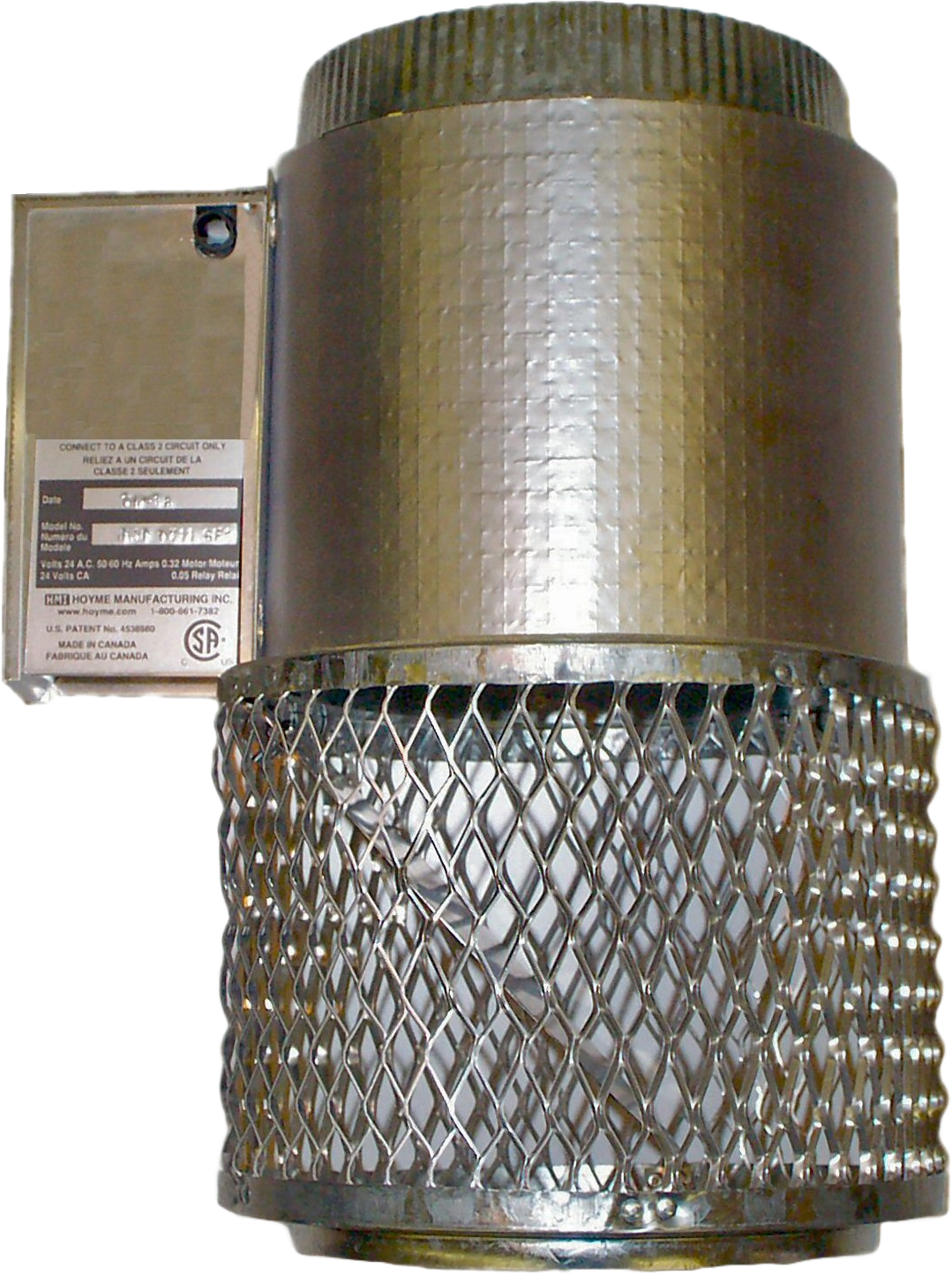
The Hoyme HOM is built around that rule. It is power closed and opens by gravity when the appliance calls for heat. Its end switch is wired in series with the thermostat wire to W, so the call for heat cannot reach the appliance until the blade has physically opened.
- If the damper fails to open, the end switch never closes and the appliance does not fire.
- If the damper were to close during firing, the end switch opens the circuit and the call for heat drops out.
- On a power failure, the damper drops open by gravity, which is the safe direction for a combustion air path.
On a standard 24 Vac furnace or boiler, the HOM wires directly into the thermostat or aquastat circuit and no extra relay is needed. For millivolt standing pilot systems or 120 Vac safety controls, an ADP relay adaptor provides the same interlock. Every HOM includes the relay and end switch, and it is Canada/USA CSA certified as a 24 Vac combustion air damper.
Sizing the opening: use the code, not a rule of thumb
The IFGC sizes outdoor combustion air by total appliance input. The common outdoor methods in Section 304.6 are:
- Two openings direct to outdoors or through vertical ducts: 1 square inch of free area per 4,000 Btu/h for each opening.
- Two openings through horizontal ducts: 1 square inch per 2,000 Btu/h for each opening.
- One opening: 1 square inch per 3,000 Btu/h, and not less than the combined area of the vent connectors.
These are larger than the general guidance printed in some damper installation instructions, so size the duct to the method your jurisdiction uses, then match the HOM to that duct diameter. A 6 inch round duct, for example, has about 28 square inches of area, which under the one-opening method covers roughly 85,000 Btu/h of total input. Confirm net free area and the requirements for your method with the code edition in force and your building department, because local amendments are common.
The short version
- Motorized combustion air dampers are allowed under IFGC 304.10 only when they are interlocked and proven open before ignition.
- The HOM's end switch, in series with the call for heat, provides that interlock.
- Size the opening to IFGC 304.6 for your method, not a rule of thumb.
Hoyme products are made in Camrose, Alberta and qualify under USMCA. For help matching an HOM to a US installation, call free technical support at 1-800-661-7382 with the appliance input, duct layout and safety circuit voltage.