
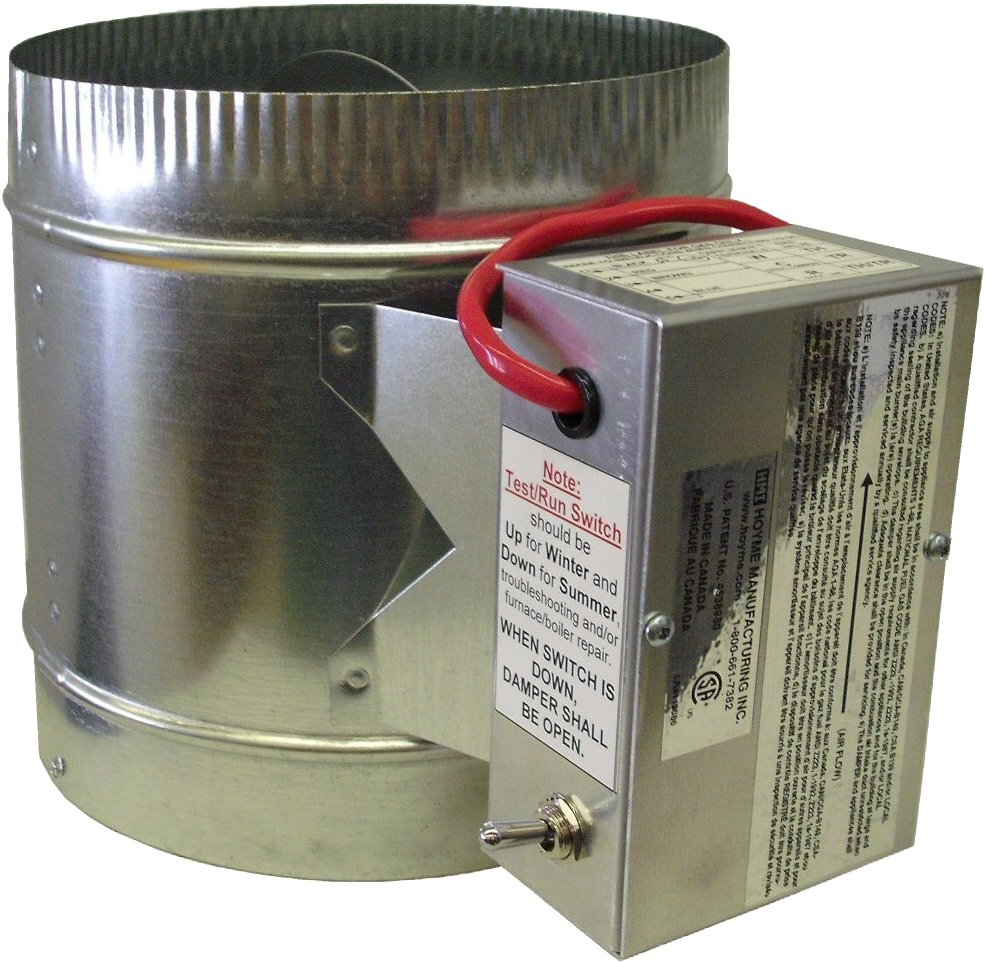
A contractor picks up a Hoyme HAC-F at the counter, wires it up and turns the power on. The damper closes, with the appliance sitting idle. That can look wrong for a flue damper.
It is not wrong. The HAC-F is held closed between firing cycles and opens before the appliance fires. This guide covers how the HAC-F works, how its interlock proves the flue is open, and how to wire it.
Why It Closes When Powered
The HAC-F is Power Close / Spring Open, designated SPC-F. With 24 Vac applied and the appliance not firing, the damper is held closed. That stops warm air escaping up the flue and cold air coming down it, which saves energy and protects the heat exchanger during the off cycle.
When the thermostat calls for heat, power to the damper motor is cut and the return spring opens the damper. If power is lost at any time, the spring opens it the same way. The flue is clear whenever the damper has no power, and it takes power to close it.
How the Interlock Sequence Works
The HAC-F end switch is wired in series with the thermostat wire to "W". The appliance only sees the call for heat once the damper has opened.
- The appliance is off and the HAC-F is powered closed.
- The thermostat calls for heat.
- The HAC-F relay cuts power to the damper motor and the spring opens the damper.
- The end switch closes when the damper is open and completes the circuit to "W".
- The appliance fires with the flue open.
- When the call ends, the appliance shuts down and the damper is powered closed again.
If the damper does not open, because of a motor fault, a broken spring or a frozen blade, the end switch does not close and the appliance does not fire. The appliance is held off until the flue is confirmed open.
Operating a motorized flue damper without this interlock is a safety risk and is not acceptable on permitted work. Always interlock the HAC-F with the appliance controls.
Wiring on a 24 Vac Appliance
No relay adaptor is needed on a 24 Vac appliance. The HAC-F connects directly to the appliance circuit, using W, R and C on the terminal strip or TH, TH-TR and TR on the gas valve:
- Damper blue (5) to the 24 Vac side of the transformer (R, or TH-TR on the gas valve).
- Damper brown (3) to transformer common (C, or TR on the gas valve).
- Remove the thermostat wire from W (or TH), connect it to damper black (1), and connect damper red (2) back to W (or TH).
Where the 24 Vac supply turns off during the non-firing cycle, or on oil appliances where the T-T terminals are not identified, use an auxiliary 24 Vac transformer to keep the damper closed, and phase it as the installation instructions describe. If the safety circuit is not fuse protected, install an in-line fuse and holder, part #3152-001.
After installation, sequence the appliance through at least three normal cycles to confirm proper operation.
Millivolt and 120 Vac Controls
For safety controls other than 24 Vac, relay adaptors interface the HAC-F to 250 mVdc to 100 Vdc or 120 Vac circuits. The ADP-0MV2-S5A covers millivolt combustion air and flue applications. For a 120 Vac safety control, call technical support at 1-800-661-7382 to confirm the adaptor before ordering.
The TEST/RUN Switch
Leave the TEST/RUN switch in the up (RUN) position for normal operation. Switching it down connects the thermostat wire directly to W and bypasses the interlock, which is how you check whether a no-fire problem is the damper or the appliance. The switch can also be left down through the summer, which leaves the damper open with the motor at rest.
HAC-F vs HAC-FS: Certification Matters on Permitted Jobs
The HAC-F is Canada/USA CSA certified up to 12" diameter. HAC-F sizes of 14" and larger are not CSA certified, and the HAC-FS, which is built in the same manner as the HAC-F, is not CSA certified at any size.
On any permitted job where the authority having jurisdiction will verify certification, specify an HAC-F of 12" or smaller. For larger flues, confirm acceptance with the authority having jurisdiction in writing before specifying or installing.
Can I Use a Standard HAC on a Flue Application?
No. A standard HAC with Power Open / Spring Close action fails closed on power loss. On a flue application that means the flue seals if power is interrupted while the appliance is firing. On a gas or oil appliance a closed flue during operation creates carbon monoxide accumulation and backdraft risk. The HAC-F SPC-F actuator is selected specifically for flue applications because it fails open. Do not substitute a standard HAC on a flue application regardless of size or voltage match.
Size Is the Only Selection
Every HAC-F in the 4" to 9" range ships identically configured, with the relay and end switch included and Power Close / Spring Open action on every unit. Select the size only, and match it to the flue or vent pipe diameter exactly.
- 4" flue: HAC-0411-SPC-F
- 5" flue: HAC-0511-SPC-F
- 6" flue: HAC-0611-SPC-F
- 7" flue: HAC-0711-SPC-F
- 8" flue: HAC-0811-SPC-F
- 9" flue: HAC-0911-SPC-F
From 10" up to 30", the HAC-F uses a Belimo TFB24 spring return actuator with the same Power Close / Spring Open action. CSA certification covers 10" and 12".
Installation Planning Notes
- Confirm the flue or vent pipe diameter before ordering. The HAC-F installs in the flue vent close to the appliance and matches the size of the factory-built flue.
- Plan the wiring at rough-in: motor power to R and C, the end switch in series with the thermostat wire to W, and an auxiliary transformer where one is needed.
- Confirm clearances around the actuator housing. Service access needs to be planned before the wall is closed.
- Confirm the appliance manufacturer's installation instructions accept a motorized flue damper before installation.
- Check the damper for proper operation yearly.
View the HAC-F Motorized Flue Damper
Hoyme Manufacturing is a CSA-certified manufacturer of motorized dampers and airflow controls based in Camrose, Alberta. Products are available through HVAC wholesalers across Canada.