
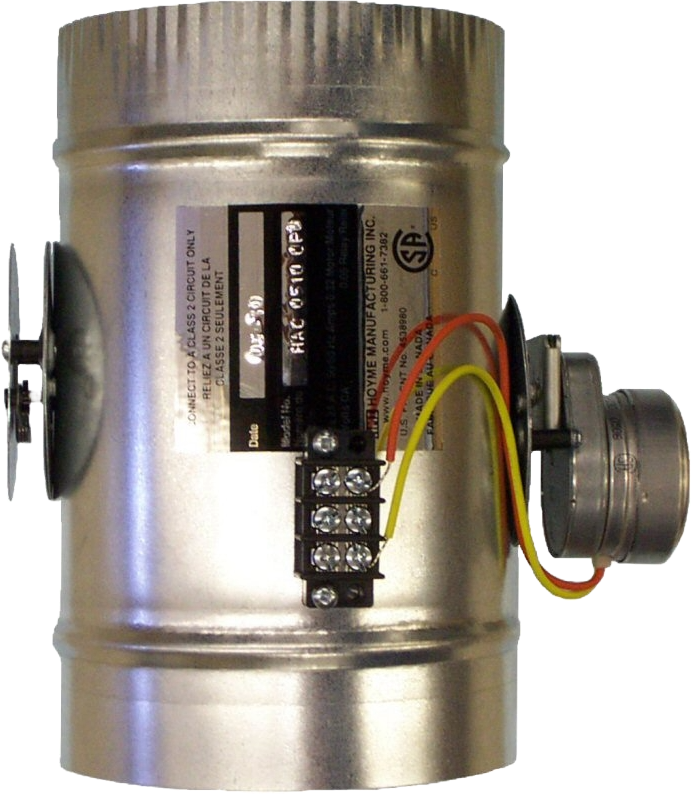
A damper specification that states size, voltage and action has described roughly a third of the product. Everything that determines whether the thing is still working in fifteen years, and whether the contractor can service it when it is not, sits in the parts nobody writes down.
The result is predictable. The spec gets met by the cheapest assembly that fits the duct, and the difference shows up as a callback three winters later on somebody else's warranty.
Here is what is worth writing into Section 23 33 13, and why each one matters.
1. Certification of the Complete Assembly
This is the single most useful line in a damper spec and it is almost never there.
A damper is a body, a blade, a shaft, bearings, seals and an actuator. Certification can be held on the actuator by itself, which tells you the motor was tested and nothing else. It says nothing about the assembly it arrived bolted to.
Write it explicitly:
"For each damper where certification is indicated, provide evidence of CSA certification of the complete damper assembly including the actuator. Certification of the actuator alone is not acceptable evidence."
That second sentence is the one doing the work. Without it you will be handed an actuator certificate at submittal review and it will technically comply.
2. Cycle Life, With a Number and a Method
Every manufacturer will tell you their damper is durable. Ask how many cycles and how they know.
"Cycle life: not less than 500,000 full open and close cycles, established by measured life test."
The number matters and so does the last clause. Established by measured life test means somebody actually ran it, rather than calculating it from component ratings. A damper on a ventilation schedule cycles several times a day for decades, and this is the specification line that separates a product engineered for that from one that was not.
3. Serviceability, Written as a Requirement
Most specs treat service as an afterthought in the closeout section. It belongs in quality assurance, because it changes which products qualify.
"Dampers shall be repairable in place. Motor kits, microswitch kits, and spring return kits shall be available as stocked replacement parts, so that a failed component does not require removal of the damper or return to the factory."
Think about what the alternative costs the owner. A motor fails on a damper buried in a ceiling space. If the product is not serviceable in place, that is a sheet metal call, a duct opening, and a damper replacement, for a failed component worth a fraction of it.
Then carry it through to closeout by requiring replacement part numbers and the names of the wholesalers stocking them in the O and M data. A parts list is only useful if somebody can actually buy from it locally.
4. Construction Method, Not Just Materials
Materials are easy to specify and most specs get that far. Galvanized body and blade, stainless shafts, nylon bearings. Fine.
How it is held together is what survives a decade of vibration in a duct.
"Assembly: bolted construction that resists loosening from vibration in service. Press-fit assemblies retained by set screws and cotter pins are not acceptable."
A set screw on a shaft works on the bench. In a duct with a blower cycling several times an hour it is a slow failure with no obvious symptom until the blade stops tracking the actuator.
5. Blade Position Control
Worth one line, and it eliminates an entire class of actuator.
"Blade angle shall be infinitely adjustable. Actuators limited to fixed detent blade positions are not acceptable."
This matters most on balancing and on any application where the damper is doing something other than full open and full closed. Detent actuators give you a handful of positions and nothing in between.
6. Fail-Safe Action, Scheduled Rather Than Delegated
Power open and power close describe what happens when power is lost, not what happens when it is applied. Power open springs closed on loss of power. Power close springs open.
Two things belong in the spec.
First, that the action is factory set and is changed only by the manufacturer's published conversion procedure:
"Action: power open (PO) or power close (PC), factory set. Action is not field interchangeable except by the manufacturer's published conversion procedure, and shall not be changed in the field on combustion air applications."
Second, and more important, schedule it. Do not leave action selection to the installing contractor. Action is the most common ordering error on motorized dampers, the two configurations are visually identical, and nobody finds out until the system is wired and energized.
Which leads to the thing most specs are missing entirely.
7. A Damper Schedule With Complete Part Numbers
If the drawings schedule dampers by size and service only, somebody downstream is making the rest of the decisions. Usually at a counter, from a phone description of the job.
"Damper schedule identifying each damper by tag, duct diameter, action, options, and complete manufacturer part number."
Three decisions determine that part number: size, action, and options. All three are design decisions. None of them belong to the installer.
The same logic applies to interlock controls. Schedule each one by damper tag, appliance or fan served, adaptor model number, and the manufacturer's wiring diagram number. Adaptor selection is a sequencing decision, and a sequencing decision is yours.
Schedule the Interlock Sequence
On any fresh air or replacement air system tied to a fan, write down what the damper and the fan are supposed to do and in what order. The sequence decides the adaptor, and the adaptor decides whether the damper needs an end switch.
Where the damper and the furnace circulation fan should simply run together on a ventilation call, a simultaneous adaptor does it: ADP-0241-05A for a 24 Vac ventilation switch, or ADP-1101-05A for a 120 Vac exhaust fan switch, with a damper without an end switch.
Where the exhaust fan must not run until the replacement air damper has proved open, write it explicitly:
"The replacement air damper shall open and prove position before the exhaust fan is energized."
That sequence requires a proving adaptor, such as ADP-1102-TPX or ADP-1103-TPX, and an end switch on the damper. Specify both, by model number, in the sequence schedule. Note that on these models the furnace circulation fan starts when the damper opens. The proving step holds the exhaust fan.
Transformer Load, While You Are At It
Easy to overlook at design and awkward to fix at commissioning.
"Size 24 Vac transformers for the connected load of all dampers and adaptors on the circuit."
A Hoyme 24 Vac spring motor damper draws 6 W at 0.32 A. Put four of them plus an adaptor on a circuit sized for a thermostat and something is going to be unhappy. Run the arithmetic at design, not after the fact.
Substitution Language That Actually Holds
Standard substitution clauses ask for equivalent product, which means nothing, because equivalence is asserted by the party requesting the substitution.
Tie it to the things you specified:
"A substituted damper shall match or exceed the specified cycle life, warranty period, certification of the complete assembly, and availability of stocked field replacement parts."
Now a substitution request has to answer four specific questions instead of making one general claim.
Commissioning Steps Worth Naming
Four checks, and they take minutes each:
- Cycle every motorized damper through at least three full cycles. Verify full open, full closed, and correct end switch operation.
- Remove control power at each spring return damper and confirm the blade drives to its fail-safe position. This is the only test that proves the fail-safe actually works.
- Verify no damper binds against duct distortion or a fastener intruding at the blade.
- On appliance interlocks, sequence through at least three normal cycles. Call for heat, damper opens, end switch proves, appliance fires, appliance shuts down, damper returns.
The power-removal test is the one most often skipped, and it is the one that matters on any life safety or combustion application.
Combustion Air and Flue Belong in Their Own Section
Dampers serving fuel-burning appliances are a different specification problem than ventilation dampers. The code references are different, CAN/CSA B149.1 and CSA B139 rather than the ventilation requirements. The interlock is mandatory rather than optional. And the fail-safe direction is dictated by safety rather than by energy performance.
Keep them in a separate section and cross-reference. Section 23 51 00 is the conventional home for combustion air and flue dampers, with damper interlock relays and airflow proving devices in 23 09 33.
A ventilation damper section that quietly also covers the combustion air damper is how a flue damper ends up specified with the wrong fail-safe direction.
Why Any of This Is Worth the Page Space
None of these lines cost anything to write. Together they change what can legitimately be submitted against the specification, which is the entire function of a product section.
The alternative is a spec that describes a hole with a blade in it, and then a review process where the only available objection is preference.
If you are working through a damper or interlock section on a live project and want to talk through the sequencing or the schedule, call 1-800-661-7382. Over 80 published colour wiring diagrams cover combustion air, fresh air, replacement air, timer, gas dryer, multi-furnace and end switch proving sequences, and if the one on your drawings is not among them it is worth a conversation before anyone writes a custom relay specification.
Technical Library: installation instructions and colour wiring diagrams
Related: combustion air, fresh air and make-up air are three different systems
Hoyme Manufacturing is a CSA-certified manufacturer of motorized dampers and airflow controls based in Camrose, Alberta. Products are available through HVAC wholesalers across Canada.