
Over fourteen days of winter testing in Ottawa, a conventional heat recovery ventilator spent about 64 hours in defrost mode. During defrost it recirculates warm stale air back into the house to melt the ice off its core, which means it is not bringing in any fresh air while it does it.
Sixty four hours out of a fourteen day stretch works out to roughly 1.7 full days. On the coldest day of the test it defrosted for six and three quarter hours.
That number did not come from us. It came from the National Research Council of Canada, who ran the test.
What the Test Was
NRC has a facility outside Ottawa called the Canadian Centre for Housing Technology. It has two research houses that are as close to identical as two buildings get. Same builder, same crews, same techniques, both built to R-2000, both about 2,200 square feet, both tighter than R-2000 requires.
They are unoccupied but they behave like they are not. There is a simulated occupancy system that runs more than 60 on/off events a day, mimicking a family of four. Dishwasher, stove, washer, dryer, lights, showers, sink draws. There are incandescent bulbs standing in for body heat, 60 watts per adult and 40 per child. Over 250 thermocouples, nine humidity sensors, and 23 gas, water and electrical meters, logged every five minutes.
The point of the twin setup is that you put the new technology in one house, leave the other alone, and the difference between them is the technology rather than the weather or the occupants or the builder.
Before the test they ran HRVs in both houses through a full heating season and a summer to confirm the two buildings performed the same. They did.
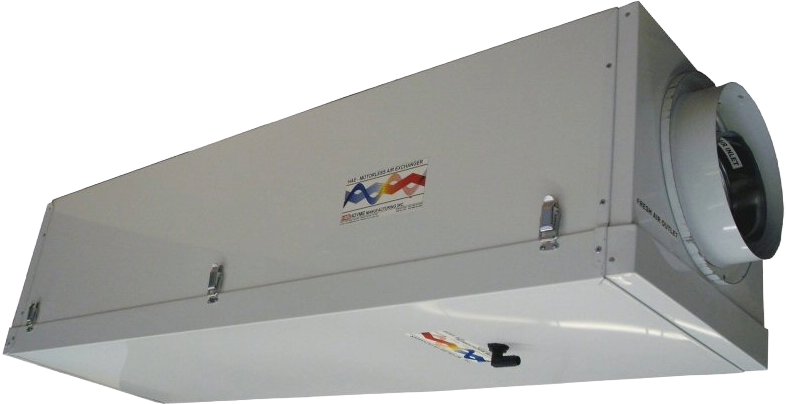
Then they pulled the HRV out of the experimental house and put in a Hoyme HAE.
Why HRVs Defrost
An HRV runs two airstreams past each other through a core. Warm stale air going out, cold fresh air coming in, heat moving from one to the other.
The problem is that warm indoor air carries moisture. When it hits a core surface that is cold enough, that moisture freezes. Keep going and the ice builds until it restricts the exhaust stream.
So HRVs de-ice. The unit stops exhausting, redirects warm house air back through the core to melt the ice, then resumes. It works. But while it is happening no fresh air is entering the building.
NRC measured the defrost time every day and plotted it against outdoor temperature. The colder it got, the longer the unit spent defrosting. On the mild days it was twenty minutes. On the cold ones it was hours.
The coldest days of a Canadian winter are exactly when a house is sealed up tightest and needs ventilation most. That is when the HRV works least.
How the HAE Handles It
The HAE has no motor in it. It is a counter-flow exchanger that uses the static pressure the furnace fan is already producing. Positive pressure in the supply plenum pushes exhaust air out through the unit. Negative pressure in the return plenum pulls fresh air in. That is why the installation instructions require the supply and exhaust ducts to land immediately on either side of the furnace fan. The fan is the motor.
The core is aluminum with twelve two inch openings running forty inches, which is deliberately coarse so frost has a harder time bridging anything. More than 3,000 square inches of heat transfer area.
The part that matters for frost is the furnace firing cycle. When the furnace fires, the exhaust air coming off the supply plenum is hot, and that heat melts whatever ice has started to form. The unit de-ices itself as a side effect of the heating system doing its job.
NRC's finding after fourteen days of Ottawa winter: no sign of frost problems, no defrost cycles required, fresh air delivered continuously through the entire test.
Effectiveness
Apparent sensible effectiveness is the standard measure here, defined under ASHRAE 80 and CSA C439. It is the heat you actually recover divided by the heat that was available to recover.
| Season | HRV | HAE unit | HAE system |
|---|---|---|---|
| Winter | 66% | 70% | 84% |
| Summer | 61% | 72% | 71% |
The unit and system columns are different things and it is worth being clear about which is which. The unit figure is the exchanger by itself. The system figure includes the concentric intake and exhaust ducting, which is doing additional heat transfer before the air ever reaches the exchanger. The 84% number is the whole system, not the box.
Electricity
This one is not close. The HRV's fans drew 1.96 kWh per day. The HAE has no fans, so the only electrical load added was the dedicated exhaust fan NRC installed for the bathrooms and kitchen, which drew 0.07 kWh per day.
That is roughly a twenty eight fold difference in ventilation electrical consumption, and it holds twelve months a year.
The Result That Went the Other Way
Winter total energy went up.
Across the two week winter test the experimental house used about 2.6% more energy than it would have with the HRV. That works out to roughly 9 MJ per day. NRC calls it small but statistically significant, and it is a real finding rather than noise.
The reason is in the airflow. The HAE ran unbalanced, with supply flow more than double the exhaust flow. Less exhaust air moving through the exchanger means less heat available to pre-warm the incoming air, so the air arriving at the furnace return plenum was cooler than it should have been. The furnace made up the difference in gas.
Summer went the other direction. Cooling and ventilation energy dropped 11.2%, about 1.38 kWh per day, and NRC attributes that entirely to the ventilation savings rather than to cooling.
So the honest summary is a trade. You give up a couple of percent on winter gas. You get continuous ventilation with no defrost gap, ventilation electrical consumption that rounds to nothing, higher measured effectiveness, and summer savings.
Whether that trade makes sense depends on what the building is being judged on. If the priority is uninterrupted fresh air through a cold snap, or getting ventilation electrical load off the panel, the HAE answers it. If the only metric is winter gas consumption, the HRV won that one by a couple of percent in this test.
Installation Matters More Than It Does on an HRV
NRC was direct about this and it deserves the same treatment here.
An HRV has its own fans, so its airflow is whatever the fans produce. The HAE borrows static pressure from the furnace fan, which means its airflow depends on the furnace and on how the ducts are tied into the forced air system. Different furnace, different static pressure, different performance.
The report lists it plainly as a dependency. Duct connections to the supply and return plenums, and airflow that follows the furnace static pressure.
Practically, that means the HAE is less forgiving of a sloppy install than a unit with its own fans. Follow the installation instructions on plenum connections. If the furnace is unusual or the duct layout is awkward, work it out before the unit goes in rather than after.
Worth noting too that the test installation ran the concentric duct through an improvised sealed opening in a basement window rather than a proper wall penetration, because it was a temporary research setup. A permanent install goes through the wall.
Read It Yourself
The full report is on our Technical Library. Assessment of the Energy Performance of Houses Using a High Efficiency Furnace Fan Generated Air Exchanger System in Side-by-side Testing, by B. Ouazia of NRC Canada and C. Hoyme, December 2014. Every table and figure quoted above is in it, including the ones that did not go our way.
Two things to keep in mind reading it. The winter test ran two weeks and the summer test ran one, so these are short windows rather than full season data. And the work was done in 2013 and 2014, which makes it eleven years old.
We publish it because side by side data from a federal lab in twin instrumented houses is worth more than anything we could claim on our own, and because a contractor deciding between two ventilation strategies should see the real numbers on both sides.
The HAE Line
The residential series covers the 100 and 200 units. Commercial applications use the 500 series and parallel configurations. The unit NRC tested was an HAE1000-100.
Installation instructions for residential and commercial, plus the system airflow diagram showing how the unit ties into the furnace plenums, are all in the Technical Library.
If you are weighing an HAE against an HRV on a specific building, call 1-800-661-7382. The answer depends on the furnace, the duct layout, and what the build is being judged on, and it is a better conversation than a spec sheet.
Related: combustion air, fresh air, and make-up air are three different systems
Hoyme Manufacturing is a CSA-certified manufacturer of motorized dampers and airflow controls based in Camrose, Alberta. Products are available through HVAC wholesalers across Canada.