
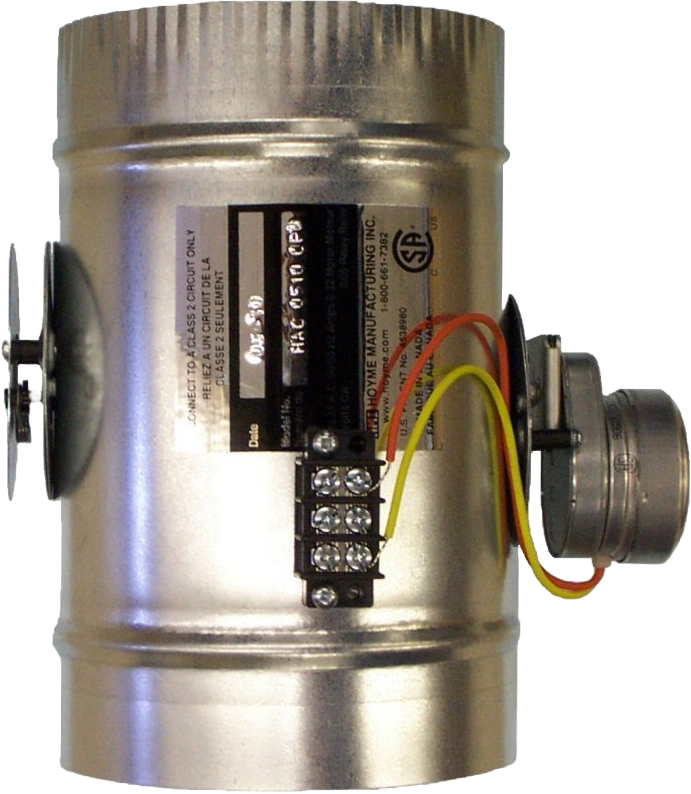
Motorized dampers look largely identical on paper. Round galvanized body, a blade, an actuator on the side, a voltage and a diameter. Two products from different manufacturers can read the same across every line of a catalogue page and behave very differently eight years into service.
The differences are real, they are just not in the part of the spec most people read. Here is what to look at, in roughly the order it matters.
What the Certification Actually Covers
This is the one worth checking first because it is the easiest to misread.
A motorized damper is a body, a blade, a shaft, bearings, seals and an actuator. Certification can sit on the actuator alone, which means the motor was submitted and tested and nothing else was. The assembly it arrived attached to was never part of that submission.
Both situations get described as certified in marketing copy. They are not the same thing, and on a job where an inspector actually looks at paperwork, only one of them holds.
Ask whether certification covers the complete assembly including the actuator, and ask for the certificate rather than the claim. If what comes back is an actuator listing, you know where you stand.
Worth noting that this cuts both ways within a single product line. A manufacturer can have certified and uncertified versions of what looks like the same damper, with the difference buried in a suffix. Read the part number on what you are actually being quoted.
Cycle Life, and Whether There Is a Number
Every manufacturer says durable. Fewer will give you a figure, and fewer again will tell you where the figure came from.
Two questions. How many full open and close cycles, and was that established by a measured life test or calculated from component ratings.
Calculated numbers are not dishonest, they are just a different kind of claim. Somebody added up the rated life of the parts. A measured life test means a unit ran until it stopped.
For reference, a damper on a ventilation schedule can cycle several times a day for decades, so the number needs to be large to mean anything. Hoyme specifies not less than 500,000 cycles, established by measured life test, and that figure is in our guide specification where anybody can hold us to it.
What Happens When the Blade Hits Something
This matters more in a cold climate than most spec sheets suggest, and it is the difference that shows up on the coldest morning of the year.
A damper blade can meet resistance. Ice at a wall termination, debris in the duct, a bit of distortion in the sheet metal. What the actuator does at that moment is a design decision and there are two common answers.
Circuit protected actuators sense the current rise and shut off to protect the motor. The motor survives. The damper is now parked somewhere between open and closed and the control system has no idea where, because it never got a position signal either way.
Stall protected actuators hold against the load without tripping. They keep holding while the condition lasts and resume normal travel when it clears. Nothing needs resetting and nothing ends up in an unknown state.
On an interior zone damper this is close to academic. On a wall termination or a combustion air intake in a Canadian winter it is not, because that is the part of the system that freezes.
Ask which one you are buying. It is rarely stated plainly and it is worth a direct question.
Whether It Can Be Fixed in Place
This is the cost difference nobody prices at purchase and everybody pays later.
A motor fails on a damper in a ceiling space or behind finished wall. The question is whether that is a motor replacement or a damper replacement, and the answer depends entirely on how the product was built and what the manufacturer stocks.
Three things to establish:
- Can the actuator be replaced without removing the damper from the duct
- Are motor, end switch and relay available as individual replacement parts rather than as a complete unit
- Are those parts stocked at wholesalers, or do they come from the factory on a lead time
A sealed assembly priced twenty dollars under a serviceable one is not cheaper. It is cheaper once, and then it is a sheet metal call and a duct opening the first time a component fails.
How It Is Held Together
Materials are easy to find on a spec sheet. Galvanized body, stainless shafts, nylon bearings. Most products in the category list something similar.
Assembly method is harder to find and it is what survives years of vibration.
A set screw holding a blade to a shaft works perfectly on a bench. In a duct with a blower cycling several times an hour it slowly backs off, and the failure mode is not dramatic. The blade just stops tracking the actuator properly, so it stops sealing and nobody notices until somebody is chasing something else.
Bolted construction that resists loosening is the thing to ask for. Press fit assemblies retained by set screws and cotter pins are the thing to ask about.
Fail Safe Direction, and Whether You Are Stuck With It
Power open opens on applied voltage and springs closed when power is lost. Power close is the reverse.
Two things worth knowing before you order.
First, that the choice is driven by the application rather than preference. A combustion air intake needs to fail open so the air path stays clear if power drops. A fresh air intake generally wants to fail closed so the building seals between cycles. Those are not interchangeable and getting it backwards is not a performance issue, it is a safety one on combustion applications.
Second, what happens if the requirement changes or somebody got it wrong. On some products the action is set at the factory and that is the end of it, so an error means a new damper. On the Hoyme HAC the actuator is accessible and there is a published conversion procedure, so a change is a service call rather than a replacement.
Sorting it out before the order is still the better plan. But it is worth knowing which situation you are in.
End Switch and Relay
Two options that get skipped at ordering and then stop an installation cold.
An end switch confirms the blade physically reached its commanded position and sends that signal back. Anything feeding an interlock circuit needs one, because without it there is nothing to prove position and the sequence cannot complete. The appliance will not fire and nothing is actually broken.
A relay gives you a switched output when the damper opens, for when the damper opening has to energize something else.
Check whether both are available on the size you need, because on some products they are not offered below a certain diameter. And check what the part number does with them, since on most lines they are encoded in the number rather than listed as accessories.
Size Range and What Drives the Big Ones
Blade torque goes up with diameter, so no single actuator covers a full size range. A manufacturer who offers 2 inch through 20 inch is using more than one drive platform to do it.
Relevant when a job has mixed branch sizes. If part of the system is past what one platform covers you are either crossing product families or looking for a second supplier for the large sizes.
Worth asking where the breakpoints are before you price a job rather than after.
Warranty Terms, Read Properly
Length is the headline and it is not the useful part.
Most motorized damper warranties split mechanical and electrical, and the electrical term is usually much shorter because that is where failures happen. A ten year warranty with a one year electrical term is a one year warranty on the part most likely to fail.
Read both numbers. Hoyme is ten years mechanical and two years electrical.
What Matters Less Than People Think
Worth saying, since a buying guide that makes everything important is not much of a guide.
Unit price, within reason. The spread between products in this category is small relative to what it costs to install one, and very small relative to one return trip. If a price difference is driving the decision, check that it is not buying away serviceability.
Small differences in power draw. It matters for transformer sizing, which is arithmetic you should be doing anyway, and it does not matter for anything else.
Finish, unless it is visible. On an exterior termination it matters. Inline in a duct it does not.
The Short Version
Before the order goes in:
- Does certification cover the complete assembly or just the actuator
- Is there a cycle life number, and was it measured or calculated
- Stall protected or circuit protected
- Can it be serviced in place, and are the parts stocked
- Bolted, or press fit with set screws
- Is the fail safe direction right for the application, and can it be changed if it is not
- End switch and relay available in the size you need
- Does one platform cover all the sizes on the job
- Mechanical and electrical warranty terms, both numbers
Most of those are a single question to whoever is quoting you, and most of them are not in the catalogue.
If you want to go through a specific application, call 1-800-661-7382. Worth doing before the order rather than after, and we will tell you if the thing you need is not something we make.
View the Hoyme motorized damper line
Related: reading and building a HAC part number
Hoyme Manufacturing is a CSA certified manufacturer of motorized dampers and airflow controls based in Camrose, Alberta. Products are available through HVAC wholesalers across Canada.