
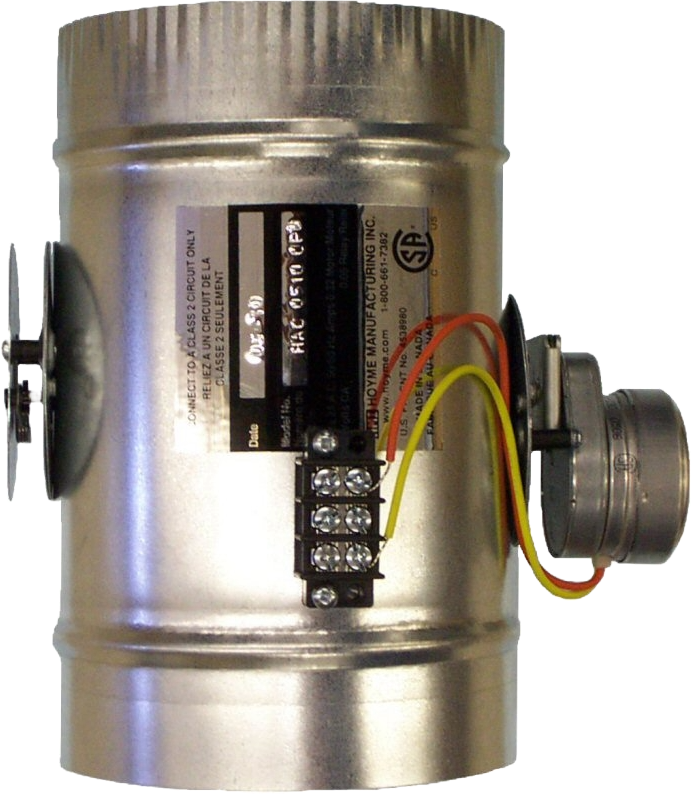
First real cold snap and the phone starts going. The mechanical room is freezing. There is a draft nobody can find. The duct running along the basement ceiling is cold enough to sweat.
Everything is installed correctly. The damper is in the duct, it is wired right, it closes when it should. And the room is still cold.
The damper is doing its job. It is just doing it in the wrong place.
The Part of the Duct Nobody Thinks About
An inline damper seals the air path wherever it sits in the run. Everything upstream of that blade, meaning everything between the damper and the outside wall, is still wide open to outdoor air.
So picture a typical install. Hood on the exterior wall, duct running eight or ten feet through the basement, damper somewhere near the appliance. Damper closes. The air path is sealed at the appliance.
That ten feet of duct is now a column of outdoor air sitting inside the building. At minus 20 it is a minus 20 pipe running through a heated space, and it stays that way for every minute the system is off, which in a heating season is most of them.
It does not feel like a draft because it is not moving. It is conduction, not infiltration, and that is exactly why it is hard to find. People go looking for air movement and there is not any. The duct is just cold, and it is pulling heat out of the room the whole time.
On a long run through a basement or a crawlspace it is enough to make the difference between a mechanical room somebody can work in and one they complain about.
Seal It at the Wall Instead
Move the seal to the building exterior and there is no duct segment left to fill with cold air. That is the whole idea behind the MOH.
It is a motorized damper and an all weather hood in one unit that mounts at the wall penetration. Blade, housing, adjustable extension sleeve and flashing, all one assembly. When it closes, the air path is sealed at the outside face of the building. Nothing behind it is open to outdoors.
It handles fresh air intake, combustion air at the wall, and make up air at the building face. CSA certified, 24 Vac, available 4 through 8 inch.
Worth noting on the certification: it covers the complete assembly. Motor, blade, housing, all listed configurations. Not the actuator by itself, which is what a lot of products in this category are carrying when they say CSA compatible. If you are dealing with an inspector who actually checks, that distinction comes up.
The Other Thing a Passive Hood Does in February
A passive hood has a permanent opening in it. That is the design.
Which means snow drifts into it, and ice builds in it, and on an exposed wall facing the wrong direction it can partially block itself over a winter without anybody noticing. On a combustion air intake that is a problem with consequences well past comfort.
A motorized hood closes between cycles, so there is no standing opening collecting whatever the weather is doing.
Stall Protected Versus Circuit Protected
This one matters more on a wall penetration than anywhere else in the system, because a wall penetration is the part of the building that goes through freeze and thaw the most.
Most generic motorized termination dampers use commodity actuators with circuit protection. Blade hits an ice load, current spikes, the protection trips, and the actuator stops. The damper is now somewhere between open and closed and the control system has no idea where.
The Hoyme drive is stall protected instead. It holds against the load without tripping, keeps holding while conditions are what they are, and goes back to normal operation when the ice clears. It does not drop into an unknown state and it does not need somebody to go reset it.
Same drive family that runs across the HAC and HOM line, which also means the replacement motor kits and the service familiarity carry across everything else you have installed.
Picking the Action
Power open is the standard for intake. Blade sits spring closed at rest, opens on 24 Vac, and closes on its own when the system shuts down. Nothing comes in when nothing is running.
That covers fresh air intake, combustion air intake, and make up air.
Exhaust is where it depends. Power open if you need it to fail open, power close if you need it to fail closed. That is a sequence decision, so work it out from the control narrative rather than defaulting.
Not sure, and it is an intake, go power open.
End Switch on Combustion Air
Optional on ventilation work. Not optional on combustion air.
If the MOH is serving combustion air on a fuel burning appliance, the appliance has to prove the damper is open before it fires, and the end switch is what sends that signal. It wires into the interlock circuit through an ADP relay adaptor.
Which adaptor depends on the appliance. Millivolt safety system, meaning standing pilot with a thermopile, takes the ADP-0MV2-S5A. Standard 24 Vac furnace takes the ADP-0240-S5A.
Order the MOH with the end switch when the interlock is in play. Without it there is nothing to prove position and the sequence cannot complete. More on adaptor selection in the ADP guide.
Things to Sort Out Before It Ships
Wall thickness. The extension sleeve adjusts from 7½ to 14 inches on the L dimension, which covers 2x4 and 2x6 framing with normal cladding and drywall. Mass masonry, thick stucco assemblies and ICF can fall outside that. Measure before you order and call the factory if it does not fit the range.
Interior clearance. The motor assembly sits on the inside and has to be reachable for service and wiring. Worth a look at the framing before the hole gets cut.
The screen. A ¼ inch screen ships installed for intake. On exhaust, take it out. Leaving it in adds backpressure and gives lint somewhere to collect.
Flashing. Comes in the box, sized for siding or stucco.
Not for Dryer Exhaust
Worth saying plainly because people ask.
Dryer exhaust is lint, humidity and elevated temperature, and that is outside what the MOH is listed for. Use the BDH back draft hood, which is built for it and comes in spring close and gravity close with an optional end switch. There is a separate post on dryer terminations.
MOH or an Inline HAC
Straightforward once you know where the control point needs to be.
| Situation | What to use |
|---|---|
| The wall penetration is the right place to control it | MOH |
| Hood is already there and staying | HAC inline |
| Damper has to sit partway along the duct run | HAC inline |
| Retrofit and the old hood is coming off anyway | MOH replaces it |
| Duct runs through unheated space and you need an insulated body | HAC-L inline |
| Hot air supply zone control, needs the bypass blade | HAC-H inline |
The retrofit row is the one that comes up most. If you are already pulling a passive hood off a wall to deal with a cold duct or a drifted intake, putting an MOH back in its place solves both problems in the opening that is already cut.
Ordering
Three decisions.
- Size. 4, 5, 6, 7 or 8 inch, matched to the duct.
- Action. Power open for intake. Power open or power close on exhaust depending on the fail safe you need.
- End switch. Required on combustion air interlock. Optional otherwise.
Part number reads MOH, then size and motor code, then end switch and action. Motor code 10 is no relay, 11 includes one. O means no end switch, S means it has one.
Two year electrical and ten year mechanical, and the motor kit is a stocked part, so a motor failure does not mean pulling the whole assembly out of the wall.
If you are working out whether the wall or the duct is the right control point on a specific job, call 1-800-661-7382.
View the MOH Motorized All Weather Hood
Related: combustion air, fresh air and make up air are three different systems
Hoyme Manufacturing is a CSA certified manufacturer of motorized dampers and airflow controls based in Camrose, Alberta. Products are available through HVAC wholesalers across Canada.